Why Your Pizza is Doughy Inside Despite Appearing Properly Baked on the Outside [Causes & Solutions]
A pizza that appears perfectly browned and well-risen on the outside can still hide a doughy, undercooked interior, resulting in a heavy and unappetizing crumb. This specific failure is mostly a result of the exterior setting and browning too quickly before the heat can penetrate the center of the dough. This page details the exact causes and provides actionable solutions for achieving a light, fully-baked crumb
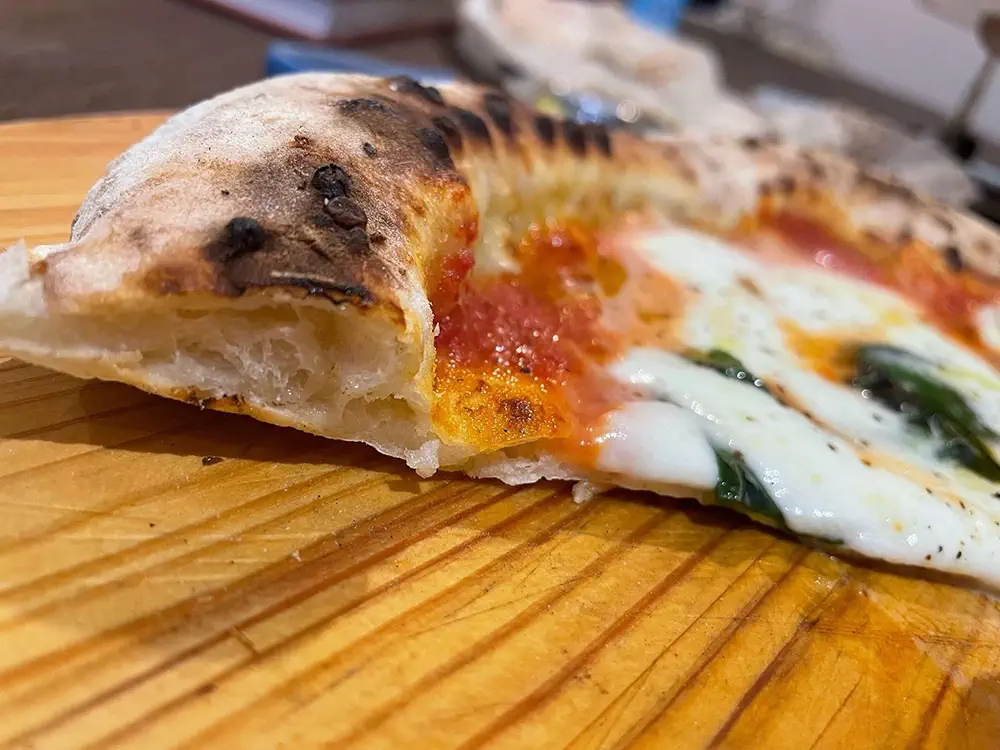
Note: This page addresses a crust that appears properly risen and browned but remains raw or doughy on the inside. If your pizza is doughy and also lacks browning or oven spring, see: Why Your Pizza Crust is Gummy, Doughy or Undercooked [Causes & Solutions].
This page is part of PizzaBlab’s Pizza Making Troubleshooting Guide. It provides a practical overview of the most common causes for this problem, each with a brief explanation, actionable solution, and links to related articles for deeper understanding.
The sections are listed from most to least likely, meaning the first cause typically represents the most common reason for this issue, with likelihood decreasing as you move down the list. That said, several causes can often overlap or share similar likelihoods – it’s ultimately up to your process to identify which factors are at play.
Cause 1: Dough Was Not Baked Long Enough (Undercooked)
Explanation:
If the dough was not baked long enough for the starch to fully gelatinize, the crust can remain doughy and undercooked.
Solution:
Bake the dough longer, ensuring it is fully set before removing it from the oven.
Read More:
Cause 2: The Dough Was Under-Fermented When Baked
Explanation:
In an under-fermented dough, insufficient CO₂ is produced by the yeast during fermentation, resulting in a dense structure. CO₂ in the dough acts as an “insulating layer”, allowing heat to distribute evenly and bake the dough properly throughout. If the dough is too dense and lacks these air pockets created during fermentation, heat passes directly through the dough, concentrating on the top and bottom (cheese, sauce, and bottom of the pizza), which causes uneven baking and leaves an undercooked dough in the middle.
Solution:
Use the dough at its optimal fermentation point and avoid baking dough that hasn’t fermented enough (see: The Dough Ferments Too Slowly or Not at All (Under-Fermentation)).
Read More:
- How to Tell if the Dough is Ready for Baking: 4 Dough Fermentation Tests
- How Oven Spring Affects Baking And Browning
Cause 3: Improper Baking Settings – Outer Crust Sets Too Quickly, Leading to Excess Moisture in the Crumb
Explanation:
Once the crust forms, the crumb stops losing moisture. If the crust sets too quickly, too much moisture is trapped in the crumb, resulting in a “wet”, doughy, undercooked crumb.
Baking settings – including temperature, oven position, baking mode, and baking time – directly affect crust formation. Finding the ideal settings for your equipment is key to achieving even, balanced baking.
Solution:
Find the optimal baking conditions for your oven. General tips:
- Adjust dough hydration to baking temperature, or vice versa (see Cause 4).
- Place the pizza on a lower rack, further from the top heating element (if available) to delay crust formation.
- Adjust oven settings; for example, using convection mode accelerates crust formation.
Read More:
- Crust Formation During Baking and How it Affects Baking and Final Texture
- The Importance of Balancing Top and Bottom Heat in Pizza Baking
- How to Bake Pizza in a Home Oven: Everything You Need to Know [A Practical Guide]
Cause 4: Mismatch Between Dough Hydration and Baking Temperature (e.g., Baking a High-Hydration Dough in a Wood-Fired Oven)
Explanation:
higher baking temperatures cause the crust to form more quickly. Once the crust forms, the crumb stops losing moisture. If dough with very high hydration is baked at too high a temperature, excessive moisture may be “trapped” in the crumb, resulting in a crumb that is undercooked and too “wet.”
As a general rule, and all things being equal (same dough, baking conditions, and times), the higher the dough hydration, the lower the required baking temperature.
Solution:
Either:
- Bake the pizza at a lower temperature for longer.
- Reduce dough hydration.
Read More:
- What Is Hydration in Dough?
- The Effect of Hydration on the Baking Process
- Adjusting Hydration to the Baking Temperature
Additional Notes / Information
The first thing to do when encountering this problem is to ensure the dough was properly fermented. If it has fermented properly, then the issue is likely the baking method – a too high temperature, too short baking time, or a combination of both.
← Back to PizzaBlab’s Troubleshooting Index
Enjoy the content on PizzaBlab? Help me keep the oven running!
![Why Your Pizza Crust is Bland or Lacks Flavor [Causes & Solutions]](https://www.pizzablab.com/wp-content/uploads/2025/11/pizza-making-troubleshooting-cover-768x561.webp)