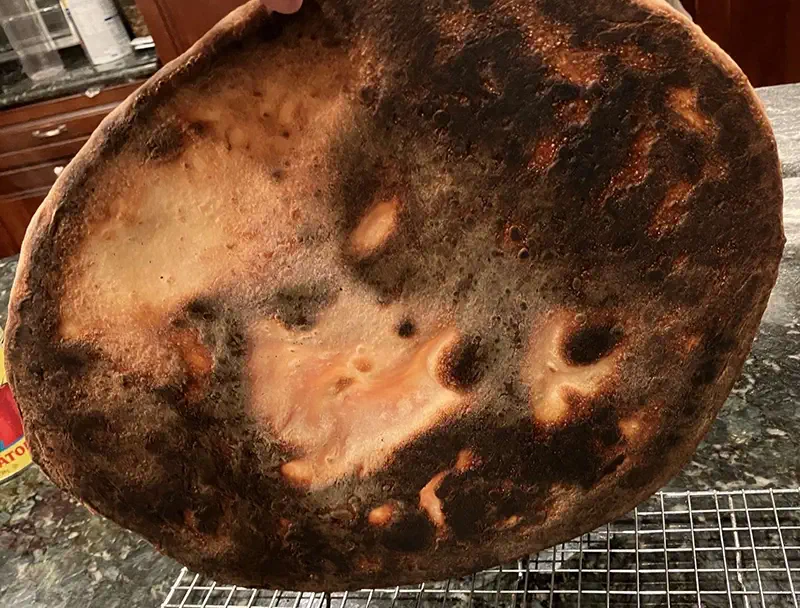
Why Your Pizza Bottom/Base Burns or Browns Too Quickly [Causes & Solutions]
A pizza bottom that burns or browns too quickly can leave the top undercooked, resulting in an unbalanced bake and a bitter flavor. This is mostly a result of excessive heat transfer from the baking surface or Improper baking settings. This page details the exact causes and provides actionable solutions for reducing bottom browning
This page is part of PizzaBlab’s Pizza Making Troubleshooting Guide. It provides a practical overview of the most common causes for this problem, each with a brief explanation, actionable solution, and links to related articles for deeper understanding.
The sections are listed from most to least likely, meaning the first cause typically represents the most common reason for this issue, with likelihood decreasing as you move down the list. That said, several causes can often overlap or share similar likelihoods – it’s ultimately up to your process to identify which factors are at play.
Cause 1: The Baking Surface or Pan Material Is Too Conductive, Resulting in Too Much Heat Transfer to the Bottom of the Pizza
Explanation:
The baking surface or pan material has a major impact on how the pizza bottom bakes. Materials with high heat conductivity might transfer heat too fast, causing the bottom to brown too fast.
Solution:
Use a less heat-conductive surface or pan (such as biscotto stone) to achieve slower, more controlled browning.
Read More:
- The Importance of Using a Baking Surface
- How the Baking Surface Properties Affect Baking and Performance
Cause 2: Too Much Bottom Heat
Explanation:
Bottom heat – transferred through the baking surface – is what bakes and browns the bottom of the pizza. If there’s too much bottom heat, the bottom of the pizza will brown too much/fast.
Solution:
Reduce bottom heat to achieve a cooler baking surface for slower baking of the pizza’s bottom. This can be achieved by:
- Using a less conductive baking surface (see previous section).
- Reducing the temperature of the lower heating element (if adjustable).
- Reducing overall temperature of the oven (allowing the baking surface to absorb less heat).
Read More:
Cause 3: Improper Baking Settings
Explanation:
Baking settings such as temperature, oven position, baking mode, or baking time directly affect browning. Finding the ideal settings for your equipment is key to achieving even, balanced baking.
Solution:
Reduce bottom heat to achieve a cooler baking surface for slower baking of the pizza’s bottom. This can be achieved by:
- Baking at a lower temperature.
- Placing the pizza on a higher rack, closer to the top heating element (if your oven has one) to increase radiant heat exposure and promote quicker browning of the top.
- Adjusting the oven settings – using convection mode or the broiler can promote top browning.
- Baking for a shorter time.
Read More:
- The Importance of Balancing Top and Bottom Heat in Pizza Baking
- How to Bake Pizza in a Home Oven: Everything You Need to Know [A Practical Guide]
Cause 4: Incorrect Flour Choice (Flour with High Enzymatic Activity – Especially When Baking at High Temperatures)
Explanation:
Flours with high enzymatic activity (such as malted flours) brown faster and are less suitable for high-temperature baking (e.g. wood-fired ovens).
Solution:
Use flour with lower enzymatic activity (such as Italian flours), which brown more slowly (especially when baking at higher temperatures.)
Read More:
- Enzymatic Activity in Flour and Choosing the Right Flour for Your Baking Temperature
- Enzymatic Activity in Italian Flours
Cause 5: For Doughs Containing Sugar – Too Much Sugar in the Dough
Explanation:
Sugar promotes and accelerates browning.
Solution:
Reduce the sugar content in the dough.
Read More:
← Back to PizzaBlab’s Troubleshooting Index
Enjoy the content on PizzaBlab? Help me keep the oven running!