The Science of Water in Pizza Dough: Minerals, pH, and Myth-Busting
While water is often overlooked in favor of flour or yeast, its chemical composition significantly impacts dough rheology and fermentation. Beyond simple hydration, the hardness and pH level of your water act as functional variables that can either strengthen or weaken the gluten network. This article explores the science of water in pizza dough, debunking common myths and identifying which type of water truly produces the best results
Introduction: Beyond Hydration – The Functional Role of Water
This article discusses the role of water as an ingredient in dough, rather than focusing on the dough’s water content (dough hydration).
Debates about the type of water used in dough aren’t as lively as those about ingredients like flour or yeast. However, water can significantly affect the dough.
In this context, two key properties of water influence the dough:
- The hardness, or mineral content, of the water.
- The acidity level (pH) of the water.
Water Hardness: The Impact of Mineral Concentration
Water hardness is a measurement of the water’s mineral content, particularly calcium and magnesium. “Hard” water contains a high concentration of these minerals, while “soft” water has a lower amount.
Water hardness is quantified by the concentration of calcium carbonate (CaCO₃), commonly expressed in milligrams per liter (mg/L). The table below classifies water hardness values globally:
| Hardness Level | mg/L (ppm) CaCO₃ | mmol/L (Europe) | gpg (US) | °dH (Germany) |
|---|---|---|---|---|
| Soft Water | 0 – 60 | 0 – 0.6 | 0 – 3.5 | 0 – 4.2 |
| Moderately Soft | 60 – 120 | 0.6 – 1.2 | 3.5 – 7 | 4.2 – 8.4 |
| Moderately Hard | 120 – 180 | 1.2 – 1.8 | 7 – 10.5 | 8.4 – 12.6 |
| Hard Water | 180 – 300 | 1.8 – 3 | 10.5 – 17.5 | 12.6 – 21 |
| Very Hard Water | > 300 | > 3 | > 17.5 | > 21 |
To check the water hardness in your area, a quick Google search should provide the information (“water hardness in [your location]”).
Hard water minerals contribute to the formation of scale or limescale. When heated, magnesium and especially calcium undergo a chemical reaction, creating scale that adheres to pipes or heating elements, such as in electric kettles.
The harder the water, the more calcium and magnesium it contains, increasing the likelihood of scale buildup.
In general, hard water is often considered healthier than soft water because it contains essential minerals.
Mineral Impact: Calcium as a Gluten Strengthener
In the context of dough, the mineral of particular interest is calcium.
Calcium acts as a gluten strengthener, much like salt, by enhancing the chemical bonds between the gluten-forming proteins. Consequently, higher calcium content in the water leads to a stronger, more elastic dough.
In simpler terms, the type of water used, specifically its hardness, has a direct and significant impact on the dough’s behavior and strength. The harder the water, the stronger the dough will be.
The minerals present in water also influence yeast activity. Higher mineral content increases yeast activity, resulting in faster fermentation.
For this reason, when making pizza dough, it’s best to use hard water, and the harder – the better.
It’s best to avoid using reverse osmosis water. Reverse osmosis strips water of all its minerals, including calcium, which inevitably results in a weaker dough.
Soft or distilled water is also less ideal for dough making.
And what about bottled natural mineral water or spring water?
Despite its name, mineral water doesn’t necessarily contain more calcium than tap water. The calcium content (and other minerals) depends on the source of the water. Depending on your location, it’s possible that the mineral water available to you has less calcium than your tap water.
For example, where I live, the tap water is hard and contains twice as much calcium as bottled “mineral” water.
Water pH: Understanding Acidity and Alkalinity
pH, which stands for “Potential/Power of Hydrogen,” measures the acidity or alkalinity (basicity) of a liquid solution.
pH levels range from 0 to 14:
- A pH lower than 7 indicates acidity.
- A pH higher than 7 indicates alkalinity.
- A pH of 7 is considered neutral.
In the context of water, pH measures the acidity or alkalinity of drinking water. Water suppliers can adjust the pH level to ensure that drinking water is safe for consumption and does not damage pipes or appliances like washing machines.
For instance, water that is too acidic (low pH) can corrode copper pipes and release harmful substances into the water. On the other hand, water that is too alkaline (high pH) can cause sediment buildup in pipes and encourage the growth of bacteria, which often thrive in non-acidic environments.
According to World Health Organization regulations, drinking water must have a pH between 6.5 and 9.5.
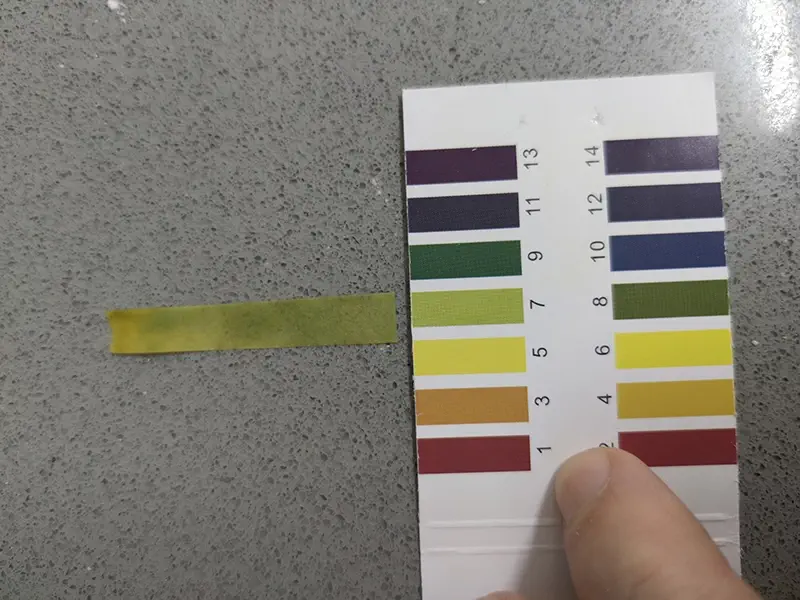
Unlike information about water hardness, the pH level of water in specific areas is not always publicly available. However, you can easily check the acidity level of your water using litmus paper (pH strips), which are inexpensive and available at pharmacies and health food stores.
In the picture below, you can see a test of tap water using low-sensitivity litmus paper (1-14). Higher sensitivity litmus papers are also available, designed for testing narrower ranges for more accurate results (e.g., 7.1-7.9, 6.1-6.9, etc.).
pH and Fermentation: Optimizing the Yeast Environment
Yeast is an organism that thrives in an acidic environment. Therefore, when making dough, it’s best to use water that is neutral or close to neutral, ideally with a pH of up to 7.5.
Using water with a pH above 7.5 may slow down yeast activity at the beginning of fermentation until the yeast produces enough acids to lower the dough’s pH. On the other hand, using acidic water (with a pH lower than 6.8) can speed up fermentation.
If you know your water is alkaline (with a pH above 7.5), you can replace 2% of the water in the recipe with standard vinegar to acidify the dough and lower its initial pH. For example, if your dough contains 200 grams of water, replace 4 grams of water with vinegar.
That said, using vinegar to acidify the dough or obsessing over the pH of your water is not necessarily recommended, as it will only have a slight effect on the fermentation rate (whether faster or slower), which can be adjusted/controlled in other ways.
A Funny Story About Water and Pizza Dough
I was once told by a pizzaiolo who considers himself a dough expert the following:
“Tap water contains chlorine that kills the yeast. If you want to use tap water in your pizza dough, you must aerate the water in an open container for at least 24 hours to let the chlorine evaporate”
While it’s true that tap water contains chlorine – a chemical added by municipalities to prevent the growth of pathogens and other contaminants – the concentrations are minimal and strictly regulated. Chlorine is considered a carcinogen, so its levels in water are closely monitored.
The low concentrations of chlorine found in tap water should have no effect on yeast activity or any other aspects of the dough.
If you have a filtration system with a charcoal filter, it should effectively remove all chlorine from the water.
In conclusion, the above claim is nonsense (and I couldn’t help but laugh when I heard it). There’s no need to aerate the water, boil it, perform any rituals, or do rain dances around it. Just add it directly to the dough.
Summary: Choosing the Best Water for Your Dough
In most cases, it’s best to use tap water for making pizza dough.
“Tap water” also includes any filtered water that does not undergo reverse osmosis, such as water from filters, water dispensers, and various types of under-sink filtration systems (2 or 3 stages).
Filtration systems that do not use reverse osmosis do not strip water of its minerals and have no effect on acidity. Thus, in terms of suitability for dough, such water is comparable to unfiltered tap water.
What types of water should you avoid? As mentioned, water that undergoes reverse osmosis or soft water are not ideal (unless you’re aiming for a more extensible dough).
Mineral/Spring water can also be used, but in most cases, tap water remains the better choice.
The only exception for using tap water is if it has an unpleasant taste that affects the flavor of the dough (which should not occur under normal conditions). In that case, using bottled mineral water is a reasonable alternative.
In conclusion, the water that is most readily available to us – tap water – will, in the vast majority of cases, be the best choice for making pizza dough.
Key Takeaways
- The Core Conclusion:
In the vast majority of cases, tap water is the best choice for pizza dough. It is readily available and generally contains the minerals necessary for a strong dough. - Water Hardness:
“Hard” water is rich in minerals like calcium and magnesium. Calcium, in particular, acts as a gluten strengthener, enhancing the bonds between proteins to create a more elastic, stronger dough. - Fermentation Boost:
Minerals act as nutrients for yeast. Higher mineral content (hard water) typically leads to more vigorous fermentation, while soft or distilled water can result in slower activity and a weaker structure. - Water to Avoid:
Avoid reverse osmosis (RO), distilled, or very soft water. These processes strip away the essential minerals (calcium) that provide dough strength and yeast nutrients, leading to a slack, overly extensible dough and sluggish fermentation. - The pH Factor:
Yeast thrives in slightly acidic environments. Ideal water for dough should be neutral to slightly acidic (pH 6.5–7.5). If your water is highly alkaline (above pH 7.5), it can slow initial yeast activity. - The Chlorine Myth:
The low concentration of chlorine in municipal tap water is strictly regulated and does not kill yeast or significantly affect the dough. There is no need to aerate or boil tap water before use. - Filtering Logic:
Standard filters (like charcoal) are fine as they remove unpleasant tastes without stripping essential minerals. Only RO systems significantly change the water’s effectiveness for baking.

Enjoyed this article? Join the BLAB
Unlock the Key Takeaways above and enjoy a 100% clean, ad-free experience across the entire site.