
Biga vs. Poolish: Choosing the Right Preferment for Your Pizza
Biga and Poolish are the two most popular preferments in pizza making, yet they offer distinct characteristics in terms of flavor, handling, and the final crust. While both serve to enhance the dough’s complexity, choosing the right one depends on your desired outcome and logistical constraints. This article provides a technical comparison to help you decide which method best suits your pizza style
Introduction: The Fundamentals of Biga and Poolish
Poolish is a liquid preferment that consists of equal amounts of flour and water, along with a small amount of yeast (e.g., 100g of flour and 100g of water – 100% hydration), and is fermented at room temperature for 6-14 hours. It originated with Polish bakers in the late 19th century and was later adopted in Austria and France. Unlike sourdough, poolish imparts a less acidic taste, which has contributed to its popularity.
Precise timing is necessary when working with poolish to prevent under or over-fermentation, as this can have a significant impact on how the dough handles. Poolish is easy to prepare and incorporate into the final dough, and it gives a mild, slightly alcoholic aroma while enhancing the dough’s extensibility and flavor.
Biga is a stiff preferment that originated in Italy. It is made with a very low hydration level (traditionally 45% hydration, resulting in a very stiff consistency), a small amount of yeast, and is fermented at room temperature for 12-24 hours at 16-18°C/60-64°F. In Italian, ‘biga’ literally means “preferment”.
The fermentation conditions and composition of biga are what give it its unique characteristics. These characteristics include slowing down protease enzyme activity to minimize gluten breakdown during fermentation and prioritizing the production of acetic acid.
As a result, biga greatly strengthens the final dough, which was its original, historical purpose. Biga is especially beneficial for high-hydration doughs like ciabatta and modern Neapolitan style pizzas. Unlike poolish, biga is more forgiving during fermentation, offering a wider usability window. However, its preparation and incorporation into the dough are more complex, often requiring a mixer due to its stiff nature.
For detailed information on how to make a poolish and a biga, please refer to PizzaBlab’s guide to preferments linked above.
The Core Differences: How Each Affects Your Dough
So what are the differences between poolish and biga in practice?
Acidity and Flavor: Lactic vs. Acetic Acid Profiles
Technically, a dough made with biga will be less acidic (higher pH) and have a sharper and more pronounced vinegar-like flavor (thanks to a higher concentration of acetic acid), as well as stronger and more elastic gluten.
A properly made biga will significantly strengthen the final dough and may result in a tougher, chewier crumb.
On the other hand, a dough made with poolish will be more acidic (lower pH), have a milder yogurt-like flavor (due to a higher concentration of lactic acid), and have more extensible gluten. A properly made poolish will increase the extensibility of the final dough and also strengthen the gluten bonds (although to a lesser extent compared to biga).
Crumb Characteristics: Tenderness vs. Chewiness
In terms of eating characteristics, dough made with biga produces a tougher and chewier crumb (due to a stronger and more elastic gluten structure), whereas dough made with poolish produces a softer crumb (due to a more extensible gluten structure).
To fully understand the concepts of elasticity and extensibility in dough and their effect on texture, it is highly recommended to read the article on Elasticity and Extensibility in Dough, which provides essential background on these properties.
Structural Impact: Extensibility, Elasticity, and Volume
Both poolish and biga contribute to increasing the volume of the baked product by strengthening the gluten. A stronger gluten can better maintain its structure and retain gases during fermentation and baking, resulting in a greater oven spring and a larger overall volume.
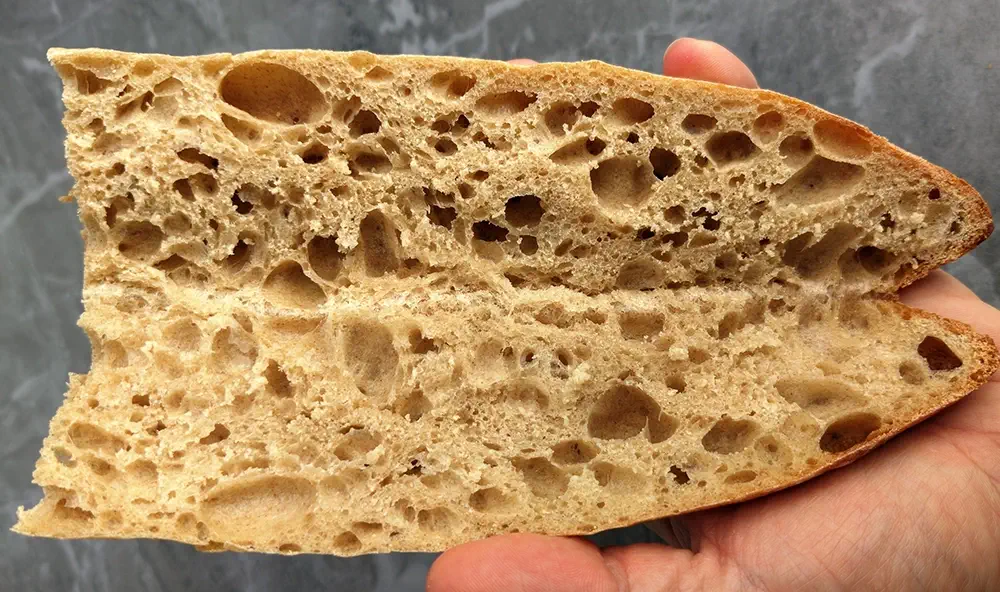
Poolish, on the other hand, adds extensibility to the dough, allowing for more “stretching” during baking. As a result, dough made with poolish yields a larger volume and a more open crumb structure compared to biga.
In terms of crumb structure, dough made with biga often exhibits large and irregular “air pockets” due to the elastic gluten’s ability to trap gases and expand without tearing. This leads to the formation of larger and fewer air pockets.
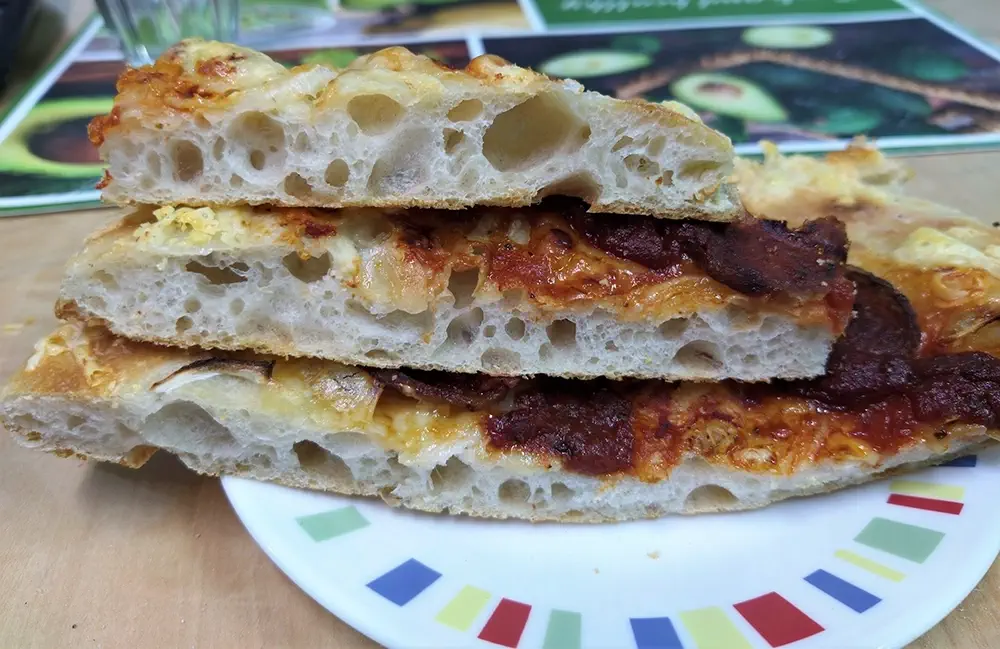
Conversely, dough made with poolish typically has smaller and more uniform air pockets. The superior stretching ability of the gluten in poolish allows for a more even distribution of gases, resulting in many small air pockets instead of larger and fewer ones.
Practical Logistics: Ease of Preparation and Timing
It is worth considering that the preparation of poolish and its incorporation into the final dough are much simpler compared to biga, but poolish has a smaller usability window, meaning more precision is required in timing its use.
On the other hand, both the preparation and incorporation of biga into the final dough are more demanding, but biga has a larger usability window, meaning less precision is required in timing its use.
When kneading by hand, it is recommended to use poolish instead of biga because adding biga to the final dough without a mixer is neither easy nor enjoyable.
Biga vs Poolish: Comparison Table
Below is a table summarizing the differences between poolish and biga:
| Preparation | Fermentation & Usability Window | Incorporation Into the Final Dough | Effect on Flavor | Effect on Texture | |
|---|---|---|---|---|---|
| Poolish | Simple | Smaller usability window, more demanding | Simple | Milder, yogurt-like flavor | A more extensible dough that will yield greater oven spring and a softer, more open and airy crumb structure, with many small air pockets |
| Biga | Requires a specific mixing procedure | Bigger usability window, less demanding | Properly incorporating biga into the final dough can be challenging. It is not recommended to use biga when kneading by hand | Sharper, more pronounced vinegar-like sour flavor | A more elastic dough that will yield a tougher, more compact crumb structure, with bigger and fewer air pockets |
Application: Using Preferments in Modern Pizza Styles
In modern pizza making, biga is typically used for doughs with a high to very high hydration level (70-80%). This is especially true for modern Neapolitan or canotto-style pizzas, which are known for their puffy, high-volume crust and open crumb structure.
However, if biga makes the dough more elastic and gives it a more compact crumb structure, why is it the preferred choice for these pizzas instead of poolish?
Firstly, these pizzas have a high hydration level, which makes the dough more extensible and helps balance the elasticity provided by the biga. Additionally, it is typical to have a generous amount of dough in the cornicione (outer part of the crust) for these pizzas.
The combination of these factors results in a large, puffy, and airy crust, giving the impression that the biga alone is responsible for this outcome. While biga does contribute to the strength of the gluten, which leads to greater volume, it is not the sole factor.
Secondly, traditionally, Italians have used biga (and continue to use it) to strengthen their typically weak doughs, which are made from weak Italian flour. For this purpose, biga is more suitable than poolish.
Lastly, biga is an Italian preferment, and Italians are known for championing their food culture. Therefore, it is only natural to see Italian pizzaiolos incorporating biga rather than poolish. Italians strongly advocate for biga to the extent that they have even developed official guidelines for its preparation.
If you were to make two identical doughs with the only difference being the use of poolish or biga, you would be surprised to find that the differences between them would not be significant.
In this context, it is worth mentioning Vito Iacopelli’s popular “poolish”; Vito’s “poolish” is an excellent example of a “preferment” that does not truly function as a preferment. It is fermented in the fridge, using a significant amount of yeast (around 2.5%), and has honey added.
This “poolish” does not contribute much to the final dough; In fact, it is not a true poolish or preferment, but rather a small portion of the final dough that has undergone a little more fermentation. In such cases, it is better to make the entire final dough at the time when you would normally make the poolish – the results will be at least the same, and in most cases, better, because now the entire dough is undergoing more fermentation, rather than just a small part of it.
Conclusion: Which Preferment Should You Choose?
Both poolish and biga are preferments that can enhance the flavor and texture of your pizza, making them excellent additions to your dough-making repertoire.
It is worth mentioning that in practice, there may not be a significant difference in the texture and taste of the final product when using dough made with biga or poolish, and both can be used interchangeably. Therefore, the choice of which preferment to use is entirely up to you.
Personally, I prefer to use poolish because I find that the extra effort required for biga is not justified by the slight difference in the final product. However, feel free to experiment with both methods and determine which one you prefer and which one suits your work process and schedule best.
Key Takeaways
- The Basics:
Poolish is a liquid preferment (100% hydration), while Biga is a stiff preferment (45–50% hydration). - Flavor Profiles:
Poolish favors lactic acid, producing a creamy, yogurt-like flavor. Biga favors acetic acid, resulting in a sharper, more vinegary-sour profile. - pH and Strength:
Both preferments lower the dough’s pH through LAB activity. This acidification tightens gluten bonds and makes the dough stronger, which contributes to an airier crust and larger volume. - Texture and Structure:
Poolish increases extensibility, resulting in a more uniform crumb structure and a more tender bite; Biga increases elasticity and strength, creating a chewier crust with larger, irregular air pockets. - Workflow and Handling:
Poolish is easier to make, but has a shorter “peak” window. Biga is more challenging to make and incorporate without a mixer, but offers more flexibility in timing. - The Final Result:
While they have distinct scientific profiles, the differences in the final pizza can be subtle. Often, the choice comes down to your equipment and your personal schedule. - Preferment Masterclass:
If you want to learn more about preferments in general, including their impact on dough, advantages and disadvantages, and detailed instructions on how to make and use them, see: Pizza Preferment Masterclass: The Science of Poolish, Biga, and Beyond.

Enjoyed this article? Join the BLAB
Unlock the Key Takeaways above and enjoy a 100% clean, ad-free experience across the entire site.

What differences would be for this:
1. biga 12h fermentation, then the final dough with 48h cold ferment
2. direct dough 72h cold ferment?
Which dough will have a better structure and better aroma?
Hi Alex,
There’s no definitive answer, the only way to know is to try both and see what works best for you.