
Biochemical Gluten Development: The Science of No-Knead Pizza Dough
Many bakers believe that high-quality gluten can only be achieved through intensive physical kneading. However, the most effective method for developing gluten, especially for long-fermented pizza dough, requires no physical force at all – a process known as biochemical gluten development. By understanding the chemistry behind how time and enzymes work together to align proteins, you can simplify your workflow while achieving a crust with superior extensibility and a lighter, more tender texture. This article explores the science of ‘no-knead’ dough, and why, for long-fermented dough, less kneading often leads to a better pizza
No-Knead Pizza Dough and Biochemical Gluten Development: An Introduction
No-knead dough, which relies on biochemical gluten development, is considered the oldest and perhaps the best method for developing gluten. In my experience, this is also the most effective method for gluten development, especially when making long-fermented pizza dough (as well as bread dough). With sufficient fermentation time, biochemical gluten development often results in superior gluten and a better texture in the final product.
The concept of no-knead pizza dough and biochemical gluten development is straightforward: the gluten in the dough continues to develop and strengthen during fermentation or any resting period.
Biochemical gluten development is an integral part of the fermentation process, especially during long fermentation of pizza dough. In practice, this means that gluten continues to develop throughout fermentation, allowing time to do the work of gluten development for us, and eliminating the need for physically kneading the dough (hence the term ‘no-knead dough’).
It is important to note that despite the term “no-knead dough”, it is still necessary to minimally knead the dough in order to properly mix all the ingredients, especially to ensure that the flour absorbs all the water – a necessary condition for gluten development, particularly in the case of no-knead dough.
The Science of No-Knead Dough and Natural Gluten Development
So, what is the mysterious process behind the concept of no-knead dough that allows gluten to form and develop naturally without kneading?
Gluten is formed when the gluten-forming proteins in the flour (glutenin and gliadin) interact with water. There are two ways in which gluten can be developed:
- Mechanically (through kneading or folding): this involves the physical “friction” between the gluten-forming proteins in the flour, in the presence of water. This friction leads to the formation of chemical bonds between these proteins.
- Biochemically: this process involves the formation of new chemical bonds between the gluten-forming proteins, which occurs naturally.
The chemistry behind biochemical gluten development is complex and can be confusing. To simplify, I will try to explain it as clearly as possible (refer to the illustration below for further clarification):
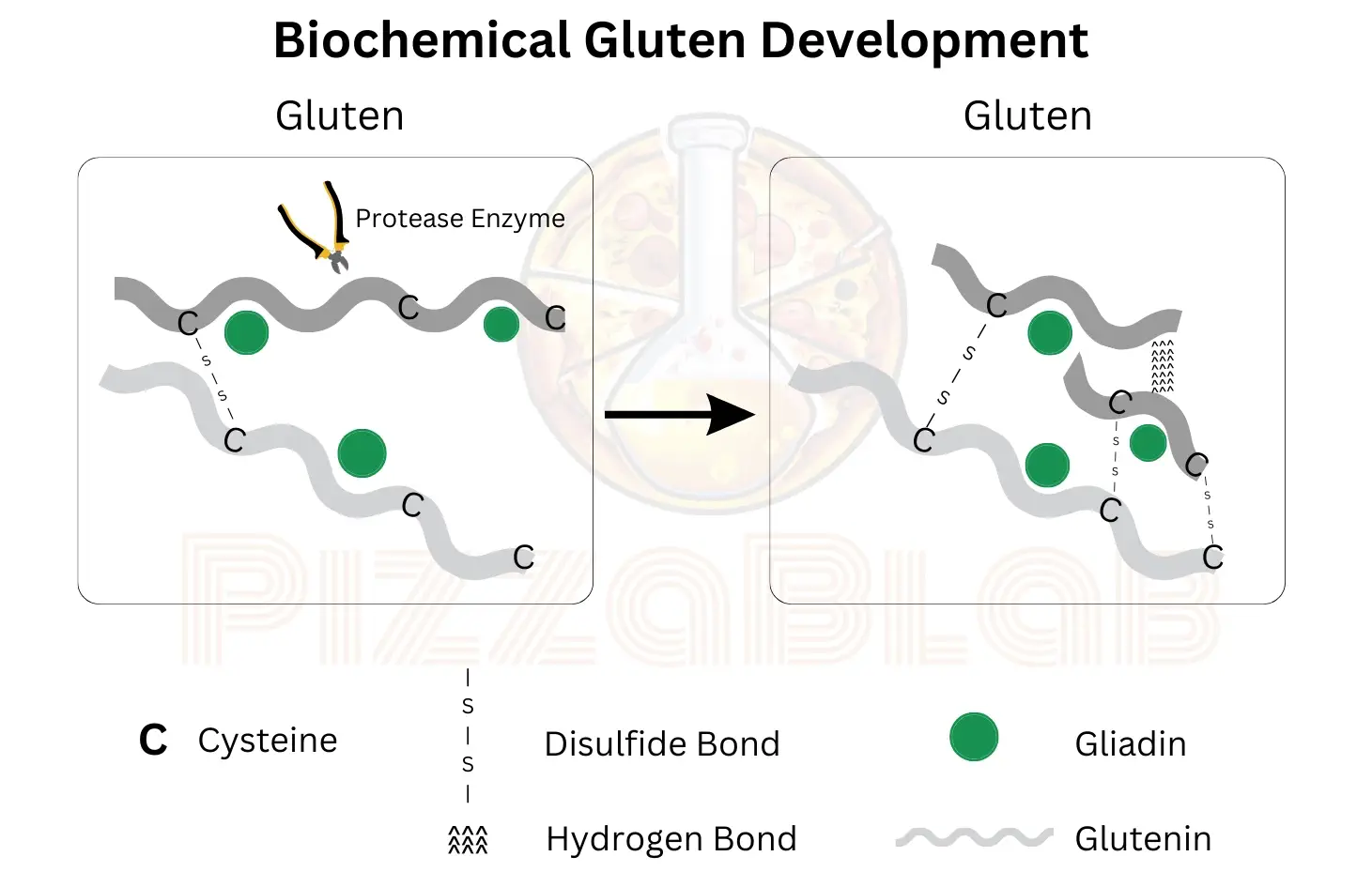
- During fermentation, protease enzymes in the dough break down gluten bonds, specifically breaking peptide bonds between proteins into shorter segments of amino acids. One of the amino acids found in these segments is cysteine.
- These shorter protein segments are more “mobile” in the dough compared to longer segments.
- When two cysteines come into proximity to each other in the presence of an oxidizing agent (oxygen in our case), a strong chemical bond called a disulfide bond (also known as an S-S bond) is formed.
- Disulfide bonds are the main chemical bonds that contribute to and influence the strength and stability of the gluten network.
- Due to the increased mobility of the smaller protein segments (resulting from the activity of the protease enzymes that break down larger protein segments), there are now more ‘interaction points’ between the cysteines of different protein segments, creating additional disulfide bonds between them.
- The disulfide bonds formed between the cysteines lead to the creation of new cross-links between the proteins, resulting in the overall strengthening of the gluten network. The more disulfide bonds that form, the stronger the gluten network will be (until all the cysteine points are “occupied”, at which point the dough reaches its maximum gluten potential).
- In addition to disulfide bonds, the peptide “fragments” can also form new, albeit weaker, chemical bonds between them (such as hydrogen bonds), further contributing to the overall strength of the gluten.
- In conclusion, the combination of these factors leads to the natural formation of new bonds between the protein segments, ultimately strengthening the gluten in the dough without any external intervention.
In a properly fermented dough, with a balance between the enzymatic activity of the protease enzymes and other fermentation processes, the ‘reconstruction’ of the gluten, driven by the protease enzymes, outweighs the degradation of the proteins. Therefore, instead of obtaining a weaker dough, we achieve a stronger dough (as long as fermentation is done correctly, until a certain point where the balance is disrupted and over-fermentation occurs).
Given enough time, biochemical gluten development will bring the dough to its full gluten potential, by maximizing the disulfide bonds between the proteins. This process occurs irrespective of the extent of kneading or folding.
In other words, biochemical gluten development enables the gluten potential of the flour to be fully utilized, similar to kneading or folding, but without relying on physical force – it relies solely on time.
It is important to emphasize (again) that the above occurs when the enzymatic activity is in sync with the maturation and fermentation processes. When this balance is disrupted, we end up with an over-fermented dough. In this case, the protease enzymes accelerate the breakdown of gluten, and in extreme cases of over-fermentation, the gluten-forming proteins are completely degraded, preventing the formation of new gluten bonds.
Furthermore, it is worth noting that once all the cysteines have formed disulfide bonds and there are no more bonding points available, the dough has reached its full gluten potential. This can occur through kneading, folding, or through prolonged biochemical gluten development. As we will explore in the next section, the method used to develop gluten has implications for both the dough and the final product.
Note that “full gluten potential” refers to maximizing the ability of gluten-forming proteins to form gluten bonds. Reaching the full gluten potential does not necessarily indicate the condition of the gluten (extensible/elastic), but rather indicates that the dough has reached the maximum gluten bonds that the flour can provide. The properties of the gluten can still vary significantly depending on the method of gluten development (as we will explore later), the duration of time the dough has spent in bulk/balls, the flour used, etc.
Comparing Mechanical vs. Biochemical Gluten Development
To fully understand the concepts discussed in the rest of this article, see Elasticity and Extensibility: The Two Core Properties of Pizza Dough, which provides essential background on dough elasticity and extensibility.
So what is the actual difference between the two types of gluten development?
Mechanical gluten development (during the physical kneading phase) occurs in the same way as biochemical gluten development, only faster – the rapid movements in the dough during kneading force the formation of disulfide (and other) bonds.
Folding the dough is a “compromise” between biochemical and mechanical gluten development. The stretching of the dough leads to a physical alignment of the gluten-forming proteins (specifically glutenins), which exposes the cysteines along the protein chain. These cysteines are then able to bind to each other following the same principle mentioned earlier.
In other words, folding accelerates gluten development, while kneading accelerates it even further.
In general, biochemically developed gluten will be more extensible and less elastic than mechanically developed gluten, assuming both doughs have reached their full gluten potential.
Mechanical kneading applies physical force to the proteins, “forcing” the formation of S-S bonds, resulting in a tightly organized gluten structure with strong cross-linking, which increases the dough’s elasticity.
In contrast, biochemical gluten development forms more random and loosely organized gluten bonds with weaker cross-linking, leading to a more extensible, less elastic structure.
Additionally, gluten developed biochemically is “drier” because the water is less evenly distributed throughout the dough (compared to mechanical kneading), resulting in incomplete hydration of the gluten-forming proteins. Since proper hydration is crucial for gluten development, this leads to weaker gluten bonds and a looser, more “relaxed” gluten structure, making it less elastic and more extensible.
‘Drier’ gluten doesn’t mean it contains less water overall, but rather that the water is bound and distributed differently within the dough structure. This unique distribution, along with a less organized protein structure, leads to a gluten network that is more extensible and less elastic compared to mechanically developed gluten.
Impact on the Final Pizza: Biochemical vs. Mechanical Development
The degree of extensibility/elasticity of the gluten directly impacts the texture of the final product. Generally, biochemically developed gluten will always produce a softer and less tough/chewy crust compared to mechanically developed gluten. It will also result in a more open crumb structure, assuming the only difference between the two doughs is the form of their gluten development.
Below is a table summarizing the differences between mechanical gluten development and biochemical gluten development:
| Biochemical Gluten Development | Mechanical Gluten Development |
|---|---|
| Produces a dough that is more extensible | Produces a dough that is more elastic |
| Produces a softer crumb and a more open (“airy”) crumb structure | Produces a tougher and chewier crumb and a more closed (“denser”) crumb structure |
In the picture below, you can see two dough balls made from the same dough (70% hydration) that I manually kneaded for 3 minutes. Immediately after kneading, I divided the dough into balls.
The dough ball on the right was folded/reballed twice, with a 30-minute rest between each fold/reballing. The dough ball on the left was left untouched after being formed into a ball. Both dough balls were fermented next to each other at a temperature of 28C/82F for a total of 4 hours. The dough ball on the right had “rested” for a little over two hours after the last fold/reballing, which was approximately half of the total fermentation time.
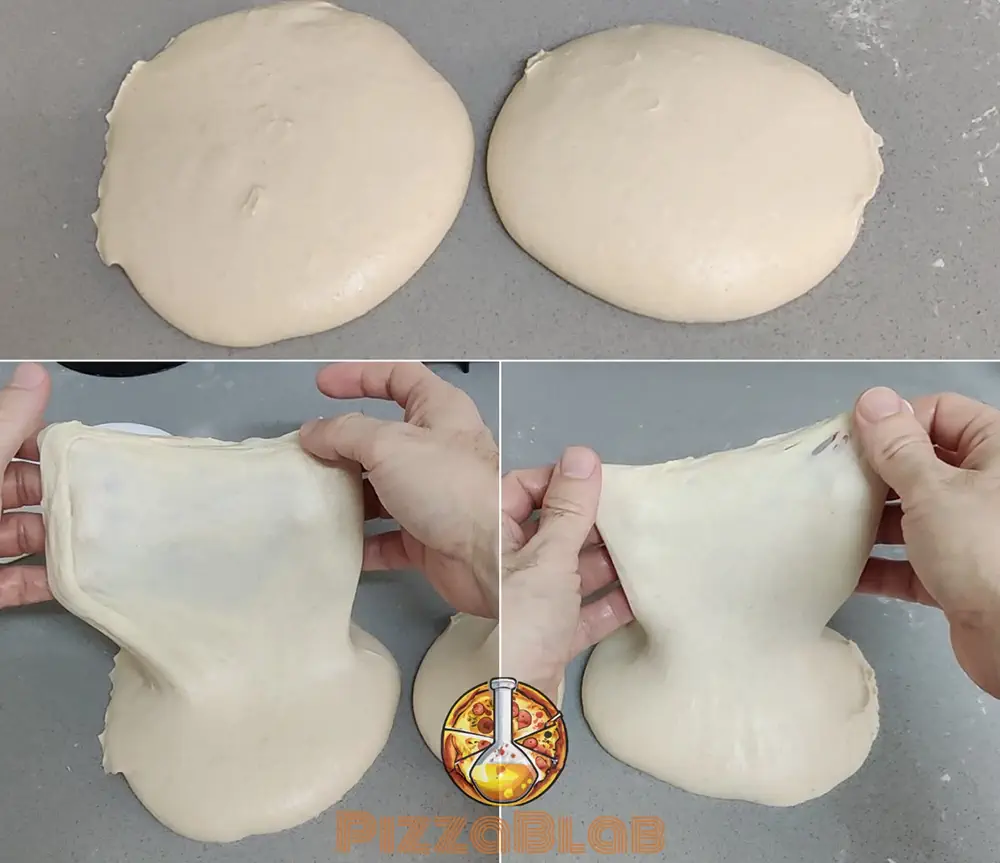
On the left: Biochemical gluten development
As you can see, the left dough ball (biochemically developed gluten) is much more extensible and stretchy (without being weaker), compared to the right dough ball (mechanically developed gluten), which was more elastic and could not be stretched further without tearing (you can observe the tearing in the upper right side of the picture).
And this, ladies and gentlemen, is biochemical gluten development.
Gluten Development in Long-Fermented Dough: Why Less is More
Reaching full gluten development (passing the ‘windowpane test‘) after kneading is desirable in bread making, especially for hearth breads that require a dough with high elasticity to hold their shape during fermentation and baking. However, it is not necessary when making long-fermented pizza dough.
For most types of pizzas, it is better to have a more extensible dough that produces an open and airy crumb structure, while still being strong enough. This is exactly what biochemically developed gluten provides.
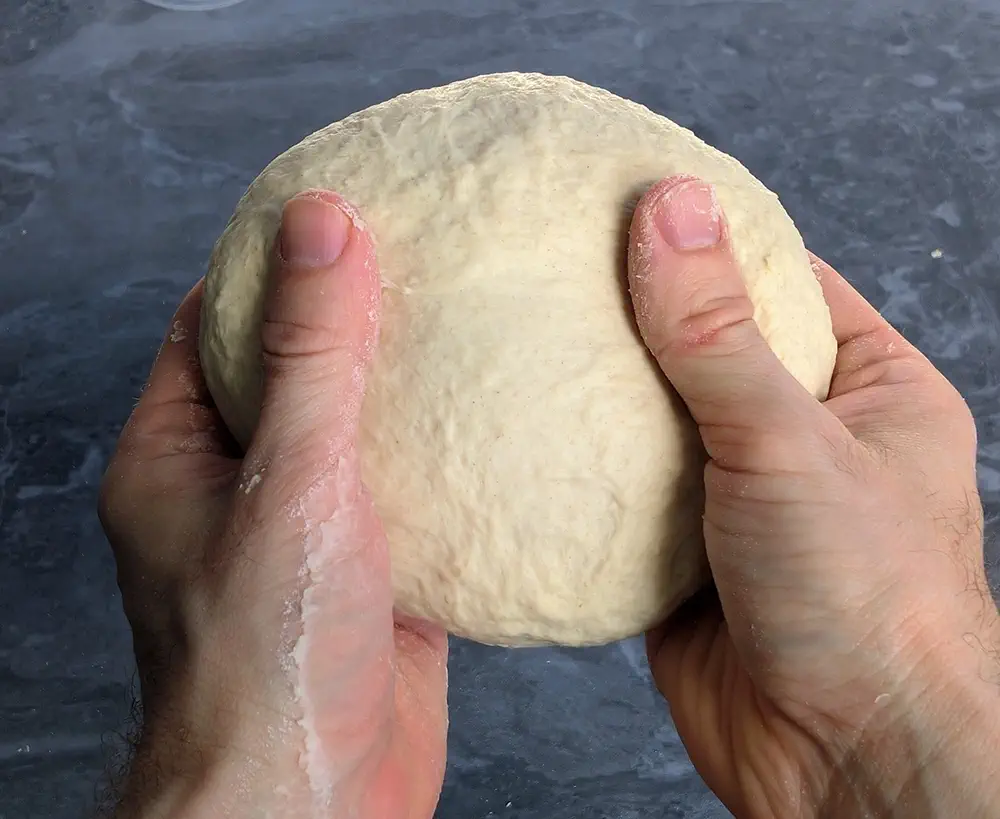
In other words, when making long-fermented pizza dough, with ‘long’ being around 6 hours at room temperature or 18 hours in the fridge, it is not necessary to reach full gluten development and pass the windowpane test after kneading. It is sufficient to achieve a relatively smooth and creamy texture, as shown in the photo below. Beyond that, we can let time do the work of gluten development. This method saves effort and yields better and more consistent results.
When it comes to eating characteristics, dough that has undergone biochemical gluten development produces a softer crumb compared to dough that has been intensely kneaded to reach full gluten development. The difference in texture is noticeable – dough that has been extensively kneaded will always result in a chewier and tougher crumb than dough that has undergone biochemical gluten development. Just for this advantage of biochemical gluten development, it is worth giving it a try.
When it comes to pizzas made with high hydration doughs, such as al taglio (around 80% hydration), which are naturally very extensible due to the high water content, it is advisable to “balance” this extensibility by increasing elasticity through kneading, folding, reballing, or reducing the time as dough balls / extending time in bulk.
Biochemical Gluten Development: Final Summary
I understand that the concept of no-knead pizza dough and biochemical gluten development may be difficult to digest (like many other things discussed on PizzaBlab). I have come across statements such as “I don’t believe in biochemical gluten development”, which is similar to believing that the earth is flat; However, I strongly encourage you to adopt this method of gluten development (or at least give it a try once), as it can greatly improve both your pizza and your work process.
The reason this gluten development method is less commonly used today is that, at the end of kneading, the dough becomes stickier and more difficult to work with and divide, and obviously – it takes time for the gluten to fully develop. In today’s commercial environment, where dough often needs to be prepared and baked quickly, biochemical gluten development has become less relevant.
However, as home bakers, there is no reason why we shouldn’t take advantage of this excellent technique. Try it!
Key Takeaways
- Beyond the Recipe:
This article explores the biochemical mechanics of “no-knead” dough, showing you how to leverage time and natural enzymatic activity to build a professional-grade gluten network without intensive physical labor. - Time as a Kneader:
Biochemical gluten development is a natural process where gluten continues to strengthen during fermentation. Given enough time, the dough will reach its full gluten potential regardless of how much it was initially kneaded. - The Role of Enzymes:
Protease enzymes “cut” long protein segments into smaller, more mobile pieces. This mobility allows for more interaction points and the formation of strong disulfide (S-S) bonds, creating a robust gluten network. - Elasticity vs. Extensibility:
Biochemically developed gluten is generally more extensible (stretchy) and less elastic (snappy) than mechanically developed gluten. This makes the dough easier to stretch and results in a lighter, more open, airier crumb. - Superior Texture:
Because it forms a more relaxed and “drier” gluten structure, biochemical gluten development consistently produces a softer, less tough/chewy crust compared to intensive mechanical kneading. - The “Less is More” Principle:
For long-fermented pizza, full gluten development at the end of the mixing stage is unnecessary. Relying on biochemical development typically produces a superior crust. - The Windowpane Myth:
While the windowpane test is crucial for short fermentations or “emergency dough,” it is not an accurate test for long-fermented doughs that will develop their strength naturally over time. - Folding as a Hybrid:
Stretch and folds serve as a middle ground, physically aligning proteins to add strength without reaching the high elasticity caused by intense kneading/mixing. - Further Reading:
For a deeper understanding of the three main kneading/mixing methods and how they affect both the dough and the baked pizza, see: Pizza Dough Kneading & Mixing Masterclass: Foundations, Methods, and Science.

Enjoyed this article? Join the BLAB
Unlock the Key Takeaways above, Get an ad-free experience on the entire site and direct, personal help with your dough or baking questions by becoming a member.

Hi Yuval! As always, great article! 🙂
What happens if I knead a dough to full gluten development and then let it ferment for a quite long time? Will protease enzymes still ‘cut’ the bonds between the peptides, or will they possibly ‘cut’ the S-S bonds?
Thanks!
-Ivan
Hi Ivan, thanks for the kind words! 🙂
During fermentation, whether long or short, protease enzymes act on the gluten network by breaking down peptide bonds between amino acids, which weakens the gluten structure. This is why dough becomes softer and more extensible over time, whether it’s during a 48-hour cold fermentation or a 2-hour room temperature fermentation. While proteases target peptide bonds, they generally don’t/can’t “cut” S-S bonds. These bonds remain intact unless broken by chemical reactions like oxidation or reduction, which is separate from protease activity.
Glutathione, for example, is a reducing agent that can act on disulfide bonds. It’s used as a dough conditioner and can also leak from yeast cells (you can read more about this in the article on using yeast).
So, during long fermentation, the gluten weakens due to protease activity breaking peptide bonds rather than disulfide bonds. This is part of why the dough becomes less elastic and more extensible over time. I have an upcoming article on this topic of extensibility and elasticity, which will be published soon.
Hope this helps!
Thank you. Seems clear now! 🙂
Hi Yuval!
Sorry, I have another question!
What does actually happen when Gluten ‘relaxes’. When kneading a dough and the gluten forms it gets tight and elastic. After some resting the dough gets ‘relaxed’ (extensible). Is this the same effect as desribed above (protease) or are here other mechanisms at play? Maybe an idea for another article? 😉
Thanks,
-Ivan
Hi Ivan, that’s a great question, which I discuss in an upcoming article on dough elasticity and extensibility 🙂 In short, at lower temperatures, materials, including gluten, tighten and become denser. As the dough cools, the gluten network becomes more elastic due to physical and chemical changes (unrelated to protease enzyme activity). As the dough warms, this elasticity decreases. It’s important to note that this effect is short-term and only impacts the dough’s handling properties.
Hi Yuval, I love your articles. This article explains so concisely what it took me a few years to cobble together an understanding, which is wonderful, and such a help for new bakers.
With this article and so many of your articles. I want references!! I want to see all the books and papers you read! Please help the geeks geek out!
Thanks for all of your work,
Ruben
Hi Ruben,
Thank you for the kind words, I’m so glad to hear that!!
Regarding references – that’s a bit of a challenge; All the information on PizzaBlab comes from years of baking, experimenting, and a ton of reading over time, the sources of which I often can’t track back 😅
Wherever possible, I do include references from relevant studies. However, much of what I write is, in a way, ‘new’ – connecting different, highly specific researched aspects of dough or pizza making into a more ‘holistic’ or complete process, essentially ‘connecting all the dots’ in ways that haven’t really been detailed before.
Best regards!
Yuval, I am the same way.
For myself, I actually owned a small neighbourhood pizzeria in the late 90s, and we just experimentally found our way to an excellent dough process. It makes sense to me now, but at the time we had no idea about what was happening, it just worked.
Hi Yuval.
Thanks for such profound and original articles!
I have some questions concerning this article:
1) Can this no-knead procedure be combined with Lehman’s method?
2) Should the amount of yeast recommended by the calculator for the Lehman’s method be modified for the no-knead procedure?
3) Won’t the final dough balls after the fridge be too sticky to stretch them with fingers into pizza disk?
Hi Arie,
1) It sure can; In fact, Tom Lehmann’s original dough management procedure relies on minimal kneading, depending almost entirely on biochemical gluten development. That said, it depends on the type of pizza and dough formula – high-hydration doughs benefit from more kneading (or stretch & folds) to ‘balance’ their natural extensibility, and the same applies to Italian flours, which tend to be more extensible by nature.
2) Nope – the calculator (and specifically the yeast suggestion) works the same way regardless of the dough formula, kneading method, etc. The only exception is when using high amounts of sugar (over 5%, which isn’t typical for pizza dough); in that case, it’s necessary to increase the yeast amount by 1.5–2 times.
3) If the dough is properly fermented, there’s no reason for it to be sticky or harder to work with 🙂
Hey Yuval,
thanks for the great article and all the work, you are doing on this website. It is very very helpful.
So basically, when I would like to prepare the most tender and tastefull Neo Neopolitan pizza. You would recommend to use Biochemical gluten developement, combined with relatively longer room temperature (like 6-8 hours) proofing?
Or is there any, better way? (Maybe use of poolish)
What I am looking for is the simpliest method, that delivers very soft, puffy dough, full of taste. Plus that it would be very easy to digest is very important to me too.
Hi Peter,
Generally speaking, yes – relying on biochemical gluten development will produce the most tender crumb. However, it’s important to find the right balance for your specific needs and preferences; Biochemically developed gluten tends to be more extensible, which might make the dough hard(er) to work with in certain scenarios (e.g., very high hydration doughs).
Another great approach is combining minimal kneading with stretch and folds. – this can also help achieve a tender crumb while maintaining better dough handling. You’ll need to experiment to see what works best for you!