
Why Large Bubbles Form in Your Pizza Base During Baking [Causes & Solutions]
Large, uncontrolled bubbles forming in the pizza base during baking push toppings aside, cause uneven cooking, and can lead to burning, ruining the overall quality of the finished pizza. This page details the exact causes and provides actionable solutions for preventing these bubbles from forming in the first place
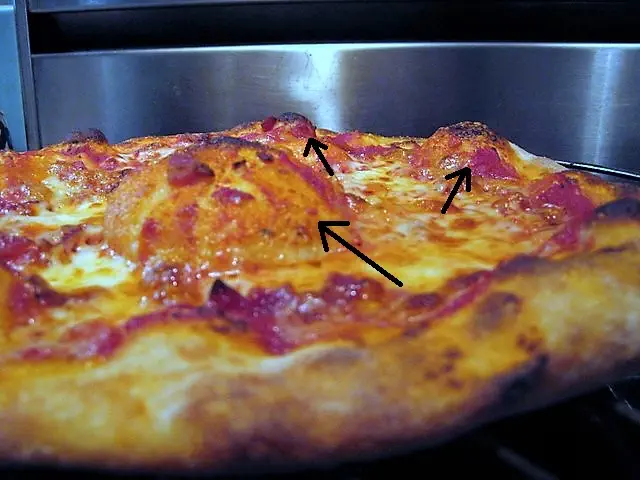
Note: Bubbles appearing in the pizza base during baking usually indicate an issue with the dough. An easy “fix” is to dock the dough using a dough docker or fork, but this only addresses the symptom, and not the root cause, as explained below.
Chain pizzerias that prioritize quantity over quality often use docking because it allows them to work with dough that is under-fermented or very cold dough, without bubbles forming during baking.
This page is part of PizzaBlab’s Pizza Making Troubleshooting Guide. It provides a practical overview of the most common causes for this problem, each with a brief explanation, actionable solution, and links to related articles for deeper understanding.
The sections are listed from most to least likely, meaning the first cause typically represents the most common reason for this issue, with likelihood decreasing as you move down the list. That said, several causes can often overlap or share similar likelihoods – it’s ultimately up to your process to identify which factors are at play.
Cause 1: The Dough Was Stretched Unevenly and Had Thin Spots
Explanation:
See the “Additional Notes / Information” section below.
Solution:
Ensure the pizza is evenly stretched to create a base of uniform thickness.
Cause 2: Insufficient Weight on the Dough
Explanation:
Areas of the dough that lack enough weight from sauce or cheese tend to be “lighter” and can puff up, forming bubbles during baking.
Solution:
Distribute sauce and cheese evenly across the entire base to provide consistent weight.
Cause 3: The Dough Was Under-Fermented When Baked
Explanation:
Dough that is baked under-fermented can form bubbles during baking because of uneven gas distribution.
Solution:
Use the dough at its optimal fermentation point and avoid baking dough that hasn’t fermented enough (see: The Dough Ferments Too Slowly or Not at All (Under-Fermentation)).
Read More:
Cause 4: The Dough Was Too Cold When Baked
Explanation:
Dough that is baked too cold can form bubbles during baking because of uneven gas distribution.
Solution:
Allow the dough to reach an internal temperature of at least 15°C (60°F) before baking.
Additional Notes / Information
During baking, steam from water evaporating in the dough accumulates at the bottom of the pizza, searching for an “escape route”. If the pizza base is of uniform thickness, the steam escapes evenly; However, thin areas provide an easier escape path, causing steam to accumulate in those areas, lifting them and forming “bubbles”.
Both insufficient fermentation and baking dough that is too cold contribute to uneven gas distribution in the dough, increasing the likelihood of bubbles forming.
Observing the pizza while baking, you may see the base continuously form bubbles that rise and fall as steam escapes. When the dough is relatively uniform, these bubbles collapse back, preventing permanent bubbles; In contrast, very thin areas accumulate steam, causing the dough to lift, stabilize, and solidify as a bubble.
← Back to PizzaBlab’s Troubleshooting Index
Enjoy the content on PizzaBlab? Help me keep the oven running!


