The Ultimate Guide to Italian Pizza Styles: History, Evolution, and Characteristics
Italy offers a wide range of regional pizza styles, each defined by unique dough techniques, baking temperatures, and local traditions. From the world-famous soft crust of Naples to the ultra-thin, crispy “Tonda” of Rome, this article explores the history and characteristics of Italy’s most iconic pizzas
Italian Pizzas: Introduction
Before discussing specific Italian pizzas, it is important to recognize the immense variety that exists throughout the country.
Italy is not a monolith when it comes to pizza; rather, each province, region, and even city has its own unique style. Attempting to cover every single variation would be a monumental task, as the landscape is as diverse as the Italian dialects themselves.
To understand Italian pizza, you must first understand the deep reverence Italians have for their culinary heritage. If you were to bring together three Italians from different regions in the same kitchen, you would likely witness a small-scale war. This illustrates a profound respect for tradition and the heritage of one’s hometown.
This level of passion extends to every corner of their cuisine. For example, if you want to see an Italian’s reaction firsthand, try mentioning that you plan on making “Fettuccine Alfredo” or putting cream in a Carbonara. This same protective energy and adherence to traditional methods are exactly what define the various “authentic” pizza styles across the peninsula.
While American pizza styles often evolved through commercialization and local equipment adaptations (like New York/Haven pizza and coal ovens), Italian pizza styles are usually defined by strict regional standards and historical techniques.
Whether it is the soft, charred crust of the south or the thin, crispy crunch of the north, these styles are a direct reflection of local ingredients and centuries-old baking traditions.
Throughout this article, we will focus on the most iconic and influential styles that have shaped not only Italian culture, but the global pizza scene. We will break them down by their characteristics, their historical roots, and the specific technical requirements that make them “authentic” in the eyes of the locals.
Disclaimer:
This article provides a comprehensive overview of the most popular pizza styles in Italy. While I have made an effort to remain faithful to the original sources in terms of authenticity and tradition, it is worth noting that while some pizza styles have specific definitions, most styles have general guidelines without a clear and precise definition of what constitutes a “Pizza X” (unless you strictly adhere to tradition).
Also, all the pizza pictures included in this post are of my own bakes; While they effectively display each pizza style, it is important to note that they should not be considered as “representative” photos; This is because it can be challenging to find a single photo that fully captures the essence of each style, even if taken from a specialized pizzeria. If you want a better idea of what each pizza looks like beyond the pictures in this post, a quick Google search of the specific pizza style will be helpful.
Traditional Italian Pizza Compositions
Margherita
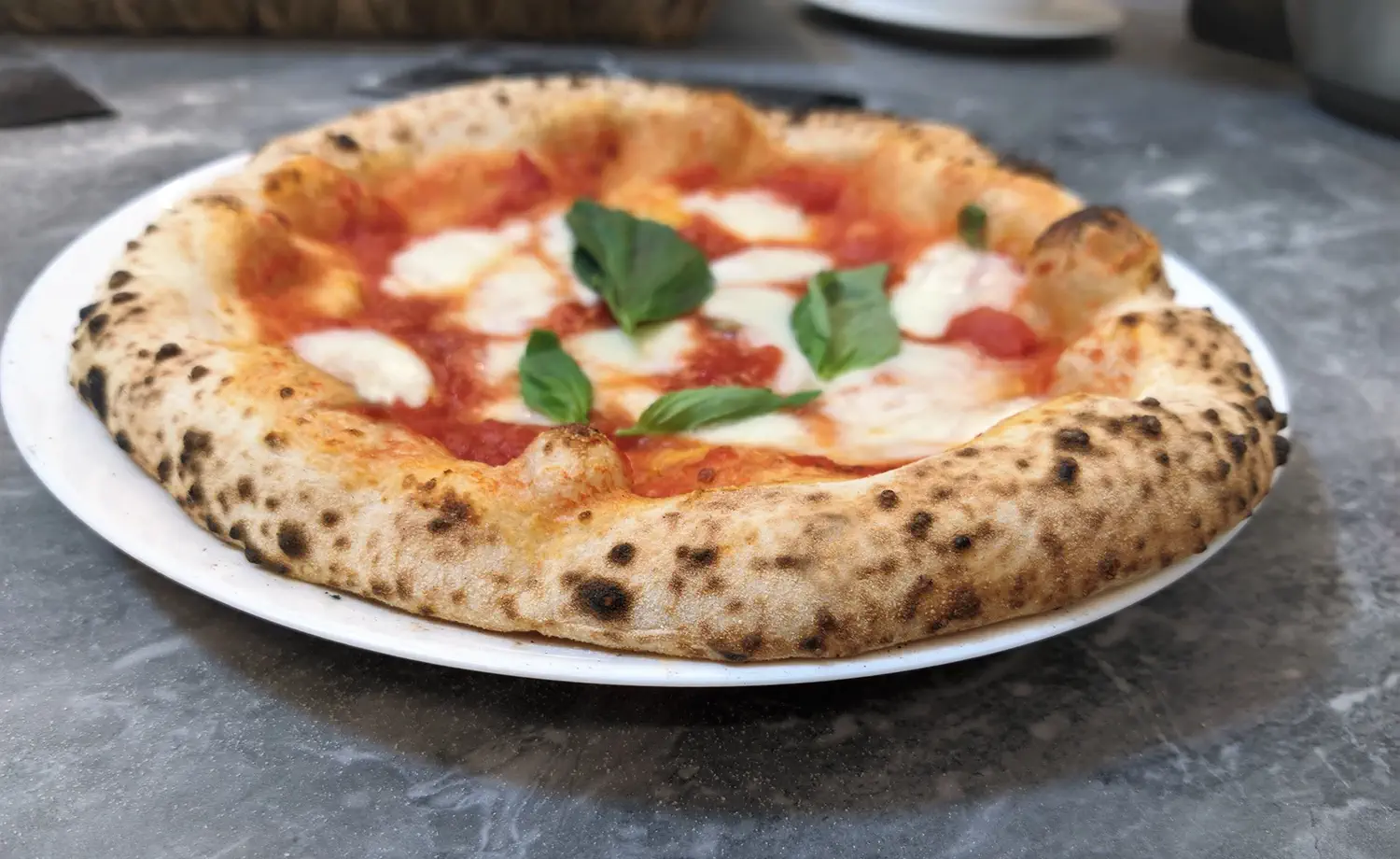
Margherita Overview
Known by every pizza lover, the Margherita is the most popular pizza in the world.
Like its older sister, the Marinara (discussed in the next section), the Margherita is famous for its simplicity and strict adherence to tradition. It is made using only three core ingredients: tomato sauce, mozzarella cheese, and fresh basil.
Note: Margherita is essentially a form of topping assembly. While we most commonly associate it with the Neapolitan style, the “Margherita” combination of toppings can be applied to almost any type of pizza base, from a New York slice to a Roman pan pizza.
The Origins of Margherita Pizza
The story of the Margherita is one of the most famous legends in the culinary world.
It centers on Raffaele Esposito, a 19th-century pizzaiolo who owned a small pizzeria called Pizzeria di Pietro e Basta Cosi. Esposito is considered by many to be the “father” of the modern pizza.
According to the tale, in 1889, Esposito was asked to create a special dish in honor of Queen Margherita of Savoy during her visit to Naples with King Umberto I. Esposito crafted a patriotic pizza showcasing the colors of the Italian flag: red tomato sauce, white mozzarella, and green basil.
Legend has it the Queen loved the pizza so much that it became a symbol of national unity for a country that had only recently been unified.
While historical records show that mozzarella had been used on flatbreads for at least 80 years prior, Esposito’s version solidified its place in the global consciousness.
Though some historians debate whether the Queen ever actually visited Naples, the Margherita successfully evolved from a humble street food for the working class, into a worldwide benchmark.
Today, the skill of a pizzaiolo is often judged solely by the quality of their Margherita.
What Defines a Margherita?
The Margherita is defined by the balance of three primary flavors: the acidity of the tomatoes, the creaminess of the mozzarella, and the aromatic freshness of the basil.
It is the classic taste that has come to define “pizza” for the entire world. When executed correctly, no single ingredient overpowers the others; instead, they combine to create what many consider the “perfect bite.”
How a Margherita is Made
The assembly of a Margherita follows a specific order to preserve the fresh flavors of the ingredients:
- The Base: A thin layer of tomato sauce is spread across the dough.
- The Cheese: Slices or chunks of fresh mozzarella are placed over the sauce.
- Oil [Optional]: A drizzle of olive oil is applied before or after the bake.
- The Basil: Fresh basil leaves are typically added post-bake to prevent them from burning and to maintain their bright aroma.
- Optional: In many traditional pizzerias, a small amount of grated hard cheese, such as Pecorino or Parmesan, is sprinkled on top for an extra layer of saltiness and umami.
Marinara
Marinara Overview
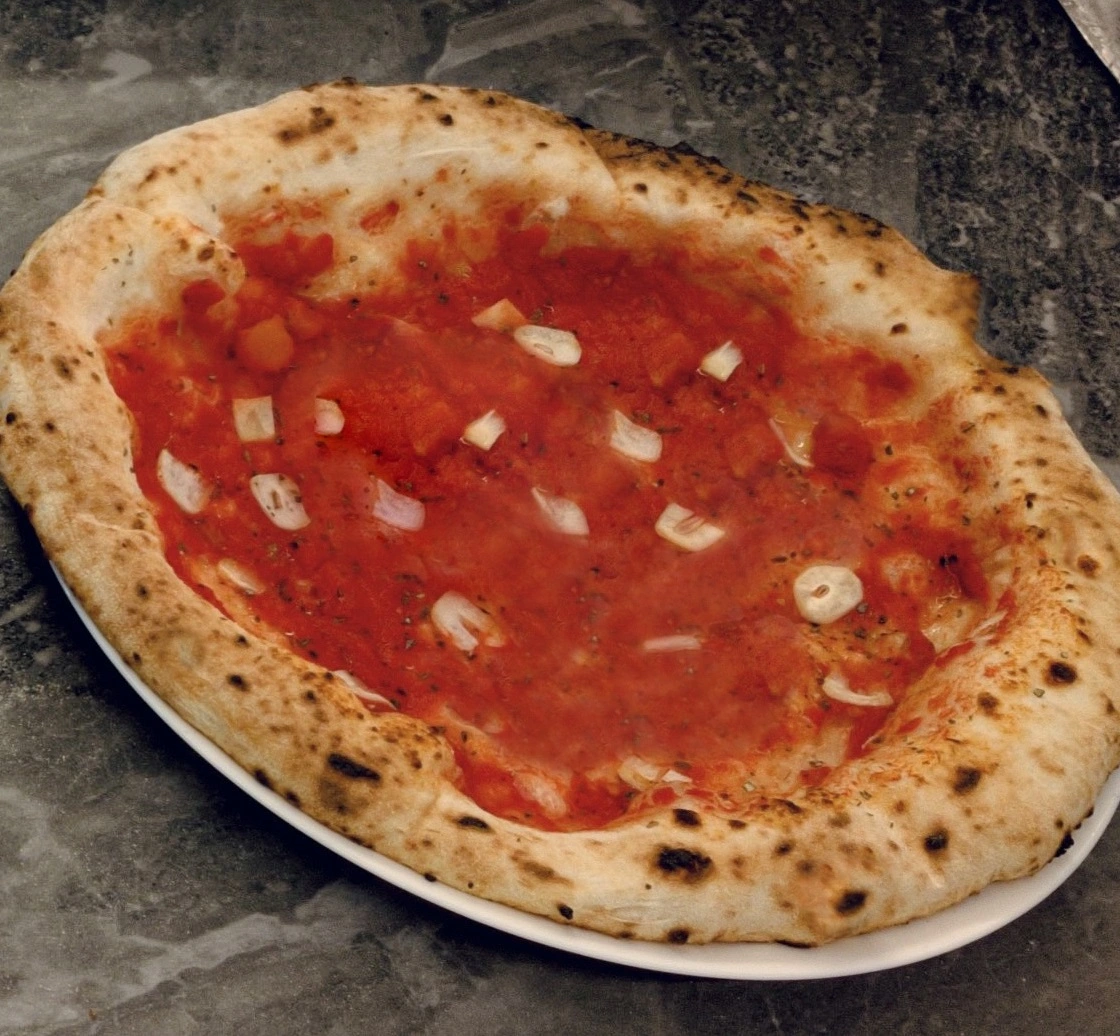
The Marinara is the “older sister” of the Margherita, and is considered one of the oldest topping compositions in the world.
It consists of just four fundamental ingredients: tomato sauce, oregano, thinly sliced garlic, and extra virgin olive oil. Notably, it contains no mozzarella or cheese of any kind.
In some regions, anchovies are added to the mix, though this leads to a confusing naming convention: in Rome, a Marinara with anchovies is often called “Napoletana,” while in Naples, that same pizza is referred to as “Romana.”
Like the Margherita, the Marinara is a method of assembly that can be applied to almost any regional pizza style.
The Origins of Marinara Pizza
The name “Marinara” often leads to confusion because of its nautical root (marinara meaning “seafaring style”). While the name suggests the sea, the pizza contains no seafood.
Its origins trace back to the late 18th or early 19th century in the port of Naples, where several legends explain its name:
- The Sailors’ Meal: The most popular legend suggests a Neapolitan pizzaiolo created this specific topping combination for the sailors and fishermen returning to the port. It was a simple, nutritious meal that relied on shelf-stable ingredients like garlic and oil.
- The Protective Wife: Another tale describes sailors’ wives preparing this pizza for their husbands’ return. They used garlic and dried oregano not just for flavor, but for their perceived antiseptic properties to help restore the sailors’ health after long voyages.
- The Scurvy Cure: Some stories claim sailors brought supplies of garlic and tomatoes back from their voyages specifically to prevent scurvy. Upon returning home, these ingredients were used to top their flatbreads.
Initially, anchovies were a common part of the dish, but due to fluctuations in price and availability, they eventually became an optional addition rather than a standard requirement.
Over time, garlic was added to the original tomato and oil base to satisfy the sailors’ demands for more intense flavor.
Regardless of the exact legend, the Marinara remains a protected standard of the AVPN (Associazione Verace Pizza Napoletana) and a symbol of Neapolitan culinary heritage.
What Defines a Marinara?
The Marinara is defined by a simple but intense flavor profile.
Without cheese to mellow the acidity, the quality of the tomato sauce and the pungency of the fresh garlic become the stars of the show. It is the ultimate “litmus test” for a pizzeria’s ingredients, as there is nowhere for low-quality produce to hide.
How a Marinara is Made
The preparation is straightforward but requires precision to ensure the garlic doesn’t burn and become bitter:
- The Base: The dough is spread with a generous layer of tomato sauce (traditionally San Marzano).
- The Aromatics: Dried oregano is sprinkled evenly across the sauce, followed by paper-thin slices of fresh garlic.
- The Finish: A spiral of extra virgin olive oil is drizzled over the top before the pizza enters the oven. The oil helps “confit” the garlic slices in the high heat, mellowing their bite and infusing the sauce with flavor.
Pizza al Piatto (Classic Italian Pizza)
Pizza al Piatto Overview
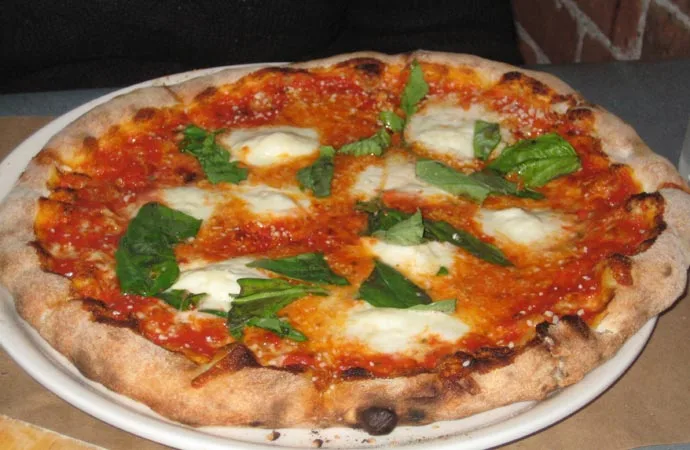
When people use the general term “Italian pizza,” they are usually referring to Pizza al Piatto.
If you hear an Italian (outside of Naples) use this term, they are talking about the standard round pizza served in sit-down restaurants. It is the most common type of pizza found across Italy and Europe.
The name “al Piatto” literally translates to “on the plate,” referring to the fact that it is a full, round pizza served as an individual meal. Characteristics-wise, this pizza is thin and moderately crispy.
If you were to place it on a scale of textures, it would sit right in the middle: not as soft and pillowy as a Neapolitan pizza, but not as shattered and cracker-like as a tonda Romana. The level of crispiness varies by region, but it remains the “classic” blueprint for Italian pizza.
The Origins of Pizza al Piatto
Because Pizza al Piatto is a broad category rather than a single regulated style, its exact origin is difficult to pin down. However, history tells us that the “original” round pizza was strictly a Neapolitan phenomenon until after World War II.
Following the war, a massive migration occurred as residents of Naples moved to central and northern Italy, particularly toward Rome and the Lazio province. These migrants began opening pizzerias, but they often lacked the specialized high-heat wood-fired ovens and specific ingredients used back in Naples, so they adapted their recipes to the tools and flours available in their new homes.
This adaptation resulted in a pizza that was baked longer at slightly lower temperatures, creating the thinner, firmer, and more widely accessible “classic” Italian pizza we know today.
What Defines Pizza al Piatto?
Pizza al Piatto is defined by its balance. Unlike American styles that might be loaded with toppings, the Italian “plate pizza” emphasizes the quality of the base.
The sauce typically consists of high-quality tomatoes with minimal seasoning, and the mozzarella is applied sparingly – often in larger chunks or strips rather than a solid blanket of cheese, to allow the flavor of the dough and the tomatoes to shine through without being weighed down by fat or moisture.
How Pizza al Piatto is Made
The preparation focuses on a manageable, reliable dough that can be stretched by hand without the extreme delicacy required for Neapolitan styles:
- Dough Formula: A simple dough formula similar to that of Neapolitan pizza. It may contain small amounts of oil (0–3%) and sugar (0–2%).
- The dough is hand-stretched into a thin, even circle.
- Bake & Temperature: It is typically baked at 280–330°C (530–620°F), for 3–7 minutes.
Neapolitan Pizza
Neapolitan Pizza Overview
Neapolitan pizza is considered the “Queen” of all pizzas, and the source of the styles we enjoy today.
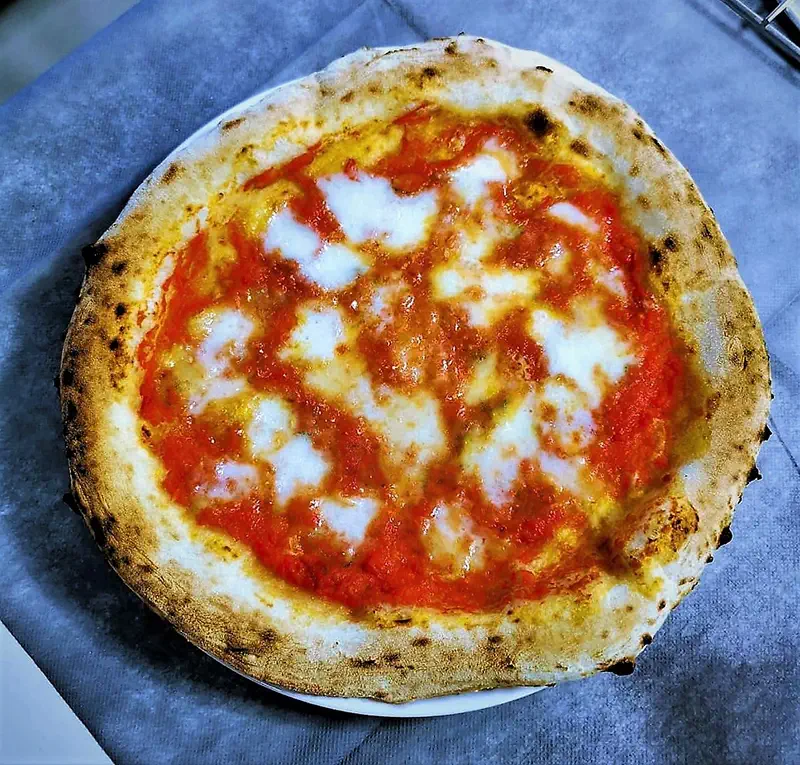
Its most distinctive feature is its cornicione (rim) – a puffy, soft, and “leopard-spotted” crust achieved by baking at extreme temperatures for a very short time.
Unlike almost any other style, Neapolitan pizza is soft and delicate, traditionally meant to be eaten with a knife and fork.
While Neapolitan pizza has become a global, photogenic trend thanks to social media and small home pizza ovens like the Ooni, in many parts of Italy outside of Naples, it remains less popular than the classic Pizza al Piatto.
Within Naples, the style is generally split into two main schools:
1. “Classic” Neapolitan (Ruota di Carro):
Translating to “cart wheel,” this is the traditional, large-diameter pizza preserved by the AVPN. It features a relatively flat but puffy crust and a thin base, harkening back to when pizza was folded into quarters and eaten as street food.

2. “Modern” Neapolitan (Neo-Neapolitan or ‘Napoletana Contemporanea’):
This category includes variations like the Canotto (“inflatable boat”) style. These pizzas often use modern techniques like high hydration, preferments, and cold fermentation to create a massive, airy crust that can take up to 50% of the pizza’s surface (not a fan, personally).

A notable street-food variation is the Pizza a Portafoglio (“wallet pizza”). This is a smaller, thinner version sold in the Centro Storico of Naples. It is folded into quarters to form a cone shape, making it the perfect “on-the-go” meal.

The AVPN and the Quest for Authenticity
To protect this heritage, the Associazione Verace Pizza Napoletana (AVPN) was established in 1984. They act as the official regulatory body, providing strict rules on everything Neapolitan pizza-related, from flour type to oven temperature.
According to the AVPN, any deviation from their protocol means the pizza is not Verace (“the real one”).
However, it is worth noting that many in the industry have reservations about the AVPN, with some suggesting the organization’s “stamp of authenticity” is more about business and politics than purely promoting quality.
The Origins of Neapolitan Pizza
Neapolitan pizza has a rich and picturesque history deeply intertwined with the city of Naples.
While ancient civilizations like the Greeks and Romans baked versions of flatbreads for thousands of years, pizza as we know it today was born in Naples in the 18th century, following the discovery of the Americas.
Tomatoes were brought to Europe in the 16th century by Spanish explorers, but they were initially met with deep suspicion. Europeans considered them poisonous, and entirely unsuitable for consumption. At the time, pizza (or flatbread) was a simple, affordable food eaten only by the working class and peasants.
The marriage of tomatoes and flatbread happened through a mix of courage, desperation, and luck. Neapolitans were the first Europeans to experiment with growing and eating these “poisonous” fruits, adding them to their leavened breads to provide extra nutrition for their families.
Unintentionally, and with a touching innocence, they forever changed the culinary culture of the world.
By 1830, Antica Pizzeria Port’Alba opened its doors. While it had operated as a hawker’s stand since 1738, this transition marked the first official pizzeria in history. From there, pizza established itself firmly in Neapolitan food culture.
During the hardships of World War II, pizzerias became symbols of hope and local resilience, continuing to feed the city despite the destruction. Interestingly, in the years following the war, pizza did not spread across Italy primarily through Neapolitans, but rather through immigrants from the town of Tramonti in the province of Salerno. It was their migration that truly took the Neapolitan tradition across the country and, eventually, the rest of the world.
In 1984, the AVPN organization was established, with the purpose of preserving the tradition and heritage of Neapolitan pizza.
What Defines Neapolitan Pizza?
When properly made, Neapolitan pizza has a unique texture and flavor profile.
The most important thing for first-time tasters to understand is that the crust is not crispy. It is soft and tender, completely lacks crispiness, and has a “liquid” or floppy center. The bottom of the crust is equally delicate, with no crispy elements at all.
Because of this soft texture, Neapolitan pizza typically features minimal toppings; a heavy load of ingredients would simply cause the slice to collapse. This distinctively soft texture sets it apart from almost every other style and can be a shock for those expecting a crunch.
To eat a slice without the toppings sliding onto your plate or clothing, it is customary to use the “envelope fold”: fold the slice in half, then tuck the tip of the slice back into its base.
In Naples, many go a step further and forego slicing the pizza entirely, choosing to eat it with a knife and fork or even rolled up as a “pizza wrap.”
How Neapolitan Pizza is Made
The AVPN guidelines provide the technical blueprint for “authenticity,” though home bakers are free to experiment:
- Ingredients: 00 or 0 flour, water, salt, and yeast. No fat (oil) or sugar is allowed.
- Dough Hydration: Between 56–63%.
- The Stretch: Hand-stretched only. using a rolling pin is strictly forbidden.
- The Bake: It must be baked directly on the stone at a scorching 485°C (900°F) for no more than 90 seconds.
- The Toppings: Traditionally limited to Marinara or Margherita using fresh mozzarella.
For a detailed Neapolitan pizza recipe, see: Classic Neapolitan Pizza Recipe [Short or Long Fermentation].
Pizza Al Taglio Romana (Roman Pan Pizza)
Roman Pan Pizza Overview
Pizza al Taglio, as its name suggests, originates from Rome, and is a distinct type of pan pizza. It is also commonly known as Pizza in Teglia (“pizza in a pan”).
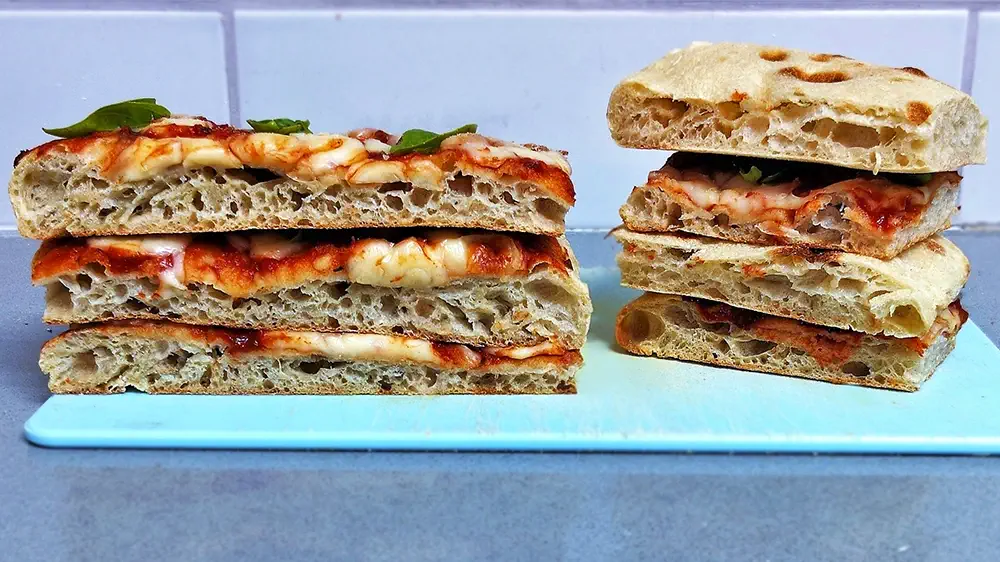
This style is baked in large rectangular pans, and then cut into squares or rectangles for service.
The name “al Taglio” translates to “by the slice,” which refers to how it is sold – typically by weight or by the slice.
Because it is baked in a pan with a very high hydration dough (up to 90%), it develops a unique structure: a bottom that is exceptionally crispy, paired with a center that is incredibly light and airy.
In Italy, al Taglio is almost exclusively a street food meant for eating on the go. Unlike other pizzas that are made to order, al Taglio is prepared in advance and displayed at a counter, much like pastries in a bakery. Customers simply point to the variety they want and specify how much they’d like to buy.
The Origins of Pizza al Taglio
Compared to the ancient history of Neapolitan pizza, the story of al Taglio is relatively modern and less documented.
Its origins are rooted in the period following World War II. As Rome became increasingly industrialized, bakers began experimenting with pan-baked flatbreads to create a convenient, quick meal for workers and people on the move.
The modern “renaissance” of this style is largely credited to Pizzarium, a Roman pizzeria run by the world-renowned pizzaiolo Gabriele Bonci (pronounced “Bahn-chi”).
Bonci is considered a pioneer who elevated al Taglio from a simple snack to a gourmet culinary experience. By using high-quality heirloom flours, long fermentation times, and innovative toppings, he transformed the style into something uncompromising and prestigious.
Today, his influence can be seen in pizzerias throughout Italy and the rest of the world.
What Defines Pizza al Taglio?
The defining characteristic of al Taglio is the contrast between its textures.
Each square offers a (very) crispy, rigid base, that supports a thick but remarkably light and tender crumb.
It is designed to be the most versatile of all Italian pizzas; the sturdy, airy dough can accommodate almost any combination of toppings, from the classic Margherita to bold, gourmet fusions that would be too heavy for a Neapolitan base.
How Pizza al Taglio is Made
The preparation of al Taglio is a highly technical process that relies on a strong flour capable of handling high-hydration dough:
- The Dough: Traditionally made with flour, water, yeast, salt, and olive oil. The hydration is the key – it must be at least 75%, often reaching as high as 90%.
- The Stretch: Although al taglio is considered a pan pizza, the dough is not fermented in the pan, but is rather carefully stretched into a long, rectangular pan just before it enters the oven.
- The Bake: It is typically baked in a deck oven at approximately 300°C (570°F) for about 10 minutes.
- The Toppings: Depending on the ingredients, the pizza is often par-baked. Toppings that are delicate or prone to drying out, such as fresh greens, certain cheeses, or cured meats, are added only after the pizza is removed from the oven, or during the final minutes of baking to preserve their texture and flavor.
Pizza Tonda Romana (Roman Thin Pizza)
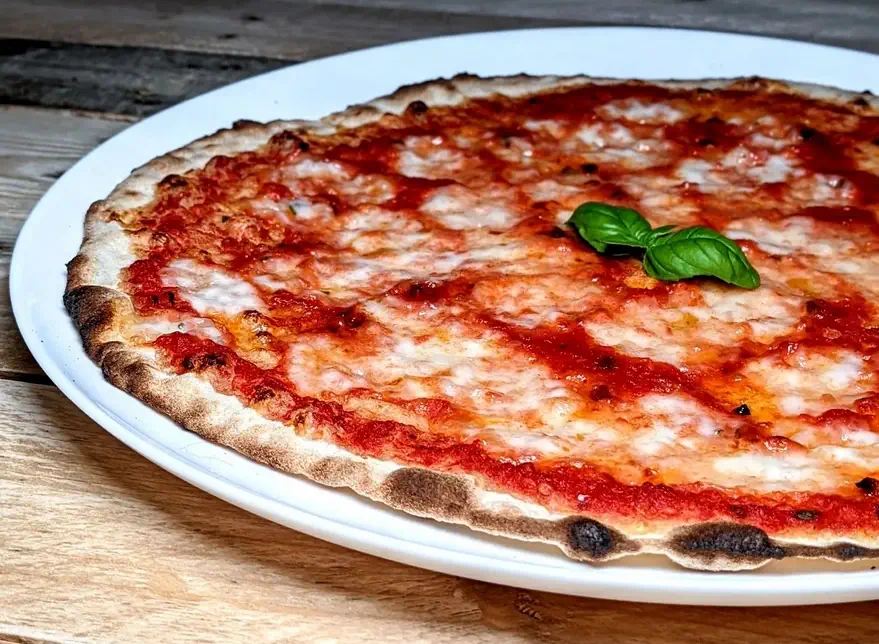
Tonda Romana Overview
The Tonda Romana is often called the “antithesis” of Neapolitan pizza.
In Rome, it is also known as Scrocchiarella, which translates to “the crispy one.” Unlike the soft, pillowy crust of the South, this is an Italian cracker-style pizza: round, extremely thin, and rigid.
The crust of a Tonda Romana is completely flat, very crispy, and often slightly charred or “well-done.” While the center may retain a slight hint of chewiness, the overall experience is one of a definitive “snap”.
Because the structure is so thin, toppings are kept minimal to prevent the base from becoming soggy and losing its crunch.
The Origins of Tonda Romana
Determining the exact origin of the Tonda Romana is difficult, as it evolved from ancient flatbread traditions.
However, popular belief suggests that Roman pizza makers developed this style after World War II as a deliberate “rival” to the Neapolitan pizza. While Naples prioritized a soft, bread-like texture, Rome moved in the opposite direction, favoring a thin, crispy base.
Today, the Tonda Romana is a pillar of Rome’s food culture. While Pizza al Taglio is the king of street food, the Tonda is the preferred choice for a sit-down dinner.
It is typically served as a whole pie in pizzerias across the capital. Outside of Rome, you can find regional variations, such as the Pizza Battuta in the Veneto region, which follows a similar ultra-thin structure.
What Defines a Tonda Romana?
The defining feature of this style is its thinness and crispiness.
The outer rim, or cornicione, is almost non-existent compared to other styles; it is flat and borders on being burnt.
If you are a fan of thin and crispy pizzas where the toppings are a light accent to a crunchy base, you’ll definitely like the Tonda Romana.
How Tonda Romana is Made
Unlike Neapolitan pizza, there is no official “AVPN-style” regulatory body for the Tonda Romana, so methods vary across Rome.
However, the general technical profile is as follows:
- The Dough: Usually a low-hydration formula of around 55%. It contains yeast, salt, and a small amount of oil, which helps the dough stretch and improves the final texture.
- The Weight: Because the pizza is so thin, the dough balls are small – typically only 180 grams for a standard 30cm (11-inch) pizza.
- The Technique: While most Italian styles forbid it, the Tonda Romana is traditionally rolled out with a rolling pin to achieve its extreme, uniform thinness.
- The Bake: It is baked at approximately 350°C (660°F) for 3–4 minutes. This longer bake time (compared to the Neapolitan 90 seconds) at a lower temperature allows the moisture to cook out completely, resulting in that iconic “scrocchiarella” crunch.
- The Toppings: Moisture is the enemy of this style. Toppings are applied sparingly, and ingredients with high water content are used with caution to ensure the dough doesn’t turn soggy.
Pizza alla Pala (Pizza Pala Romana)
Pizza alla Pala Overview
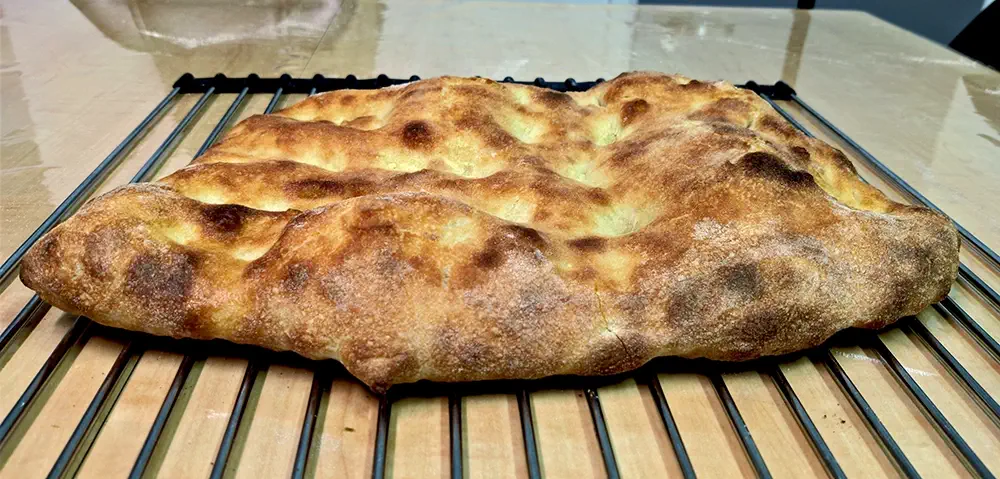
Originating from Rome, Pizza alla Pala (“paddle pizza”) is a long, rectangular pizza that is thick and airy, sharing many similarities with Al Taglio or focaccia.
However, there is one major technical difference: while Al Taglio is baked in a pan, the Pala is baked directly on the oven floor/stone.
The name “alla Pala” refers to the tool used to launch it into the oven – a long, paddle-shaped wooden peel called a pala. Like its Roman cousin Al Taglio, the Pala uses a high-hydration dough (at least 70%). It is shaped by hand into a long oval or rectangle just before baking, and slid off the paddle directly onto the stone.
The result is a pizza that is soft and cloud-like on the inside, with a contrasting very crispy crust, on both the top and the bottom.
Because of its sturdy yet airy structure, it is also frequently used as a premium bread for sandwiches.
The Origins of Pizza alla Pala
Like the previous Roman pizza styles we’ve discussed, there is no single documented “inventor” or a clear consensus on when the Pala first appeared.
The general agreement is that it was developed within the province of Lazio (Rome’s home region). It likely emerged from bakers’ desire to create a unique variation of the highly popular pan pizzas, experimenting with how the same high-hydration dough would react when exposed to the direct heat of the oven stone instead of the metal of a pan.
What Defines a Pizza alla Pala?
The defining characteristic is the contrast.
Because it is baked at a higher temperature than pan pizza (around 350°C/660°F), the outside develops a rustic, rugged crunch, while the interior remains tender and light.
How Pizza alla Pala is Made
Making a pizza pala is a masterclass in dough handling, as high-hydration dough is notoriously difficult to move without a pan:
- The Dough: Very similar to Al Taglio dough, requiring a “strong” flour and a hydration level of at least 70%.
- The Shaping: Instead of being pressed into a pan, the dough is placed on a floured work surface and gently patted into a long rectangle using only the fingertips.
- The Bake: It is transferred to the long wooden peel (‘pala’) and launched directly onto the baking surface. It typically bakes at 350°C (660°F) for approximately 5 minutes.
- The Toppings: Like the other Roman styles, you can be highly creative here. A classic and traditional pizza pala topping is a drizzle of olive oil, a sprinkle of grated Pecorino Romano, oregano, and cracked black pepper.
Pizza Pinsa

Pizza Pinsa Overview
Pinsa, often marketed as Pinsa Romana, is another rectangular style originating from Rome.
The name comes from the Latin word pinsere, which means “to press” or “to pinch” – a direct reference to the hand-pinching motion used to stretch the dough into its signature oval shape.
Visually and structurally, the Pinsa is almost identical to the Pizza alla Pala – just smaller in size. However, it carries a unique legal and commercial status.
While Romans claim the recipe dates back over 2,000 years to the Roman Empire, its modern “rebirth” occurred in 2001 (and gained massive traction around 2016) through the Di Marco family, a long-standing lineage of Roman bakers.
In a clever move to emulate the prestige of Neapolitan pizza, the Di Marco family founded the “Official Pinsa Pizza Association” and registered “Pinsa” as a trademark.
This means that in order for a pizzeria to legally call its product “Pinsa,” it must pass specific tests and be registered with the organization. Without this certification, the pizza must be referred to simply as a Pala Romana.
Today, there are over 7,000 “Pinsaiolos” worldwide officially trained by the Di Marco family to carry on the tradition.
What Defines a Pizza Pinsa?
What truly separates a Pinsa from a standard Pala? The answer lies in the flour. Authentic Pinsa is defined by a specific, patented mixture sold by the Di Marco family, consisting of wheat, soy, and rice flours, along with dried sourdough.
According to the official narrative, this blend makes the pizza “more digestible” and lower in fat and calories than traditional wheat-only doughs.
That said, the eating experience is very similar, if not identical to the Pizza Pala – featuring a thick, airy interior and a crispy exterior. The small amounts of rice & soy flour and dried sourdough give the crust a slightly different texture and flavor.
How Pizza Pinsa is Made
Because it is a trademarked style, the preparation instructions are very precise and strictly monitored by the pinsa association:
- The Flour: Must be the original Di Marco blend. If a baker is making an “inspired” version, the ratio is typically 80% wheat, 8% rice flour, and 2% soy flour.
- The Hydration: Must be exactly 80%.
- The Process: The dough contains 1.5–2% salt and 1–1.5% olive oil. The dough balls are small (130–250g) and must undergo a cold fermentation for a minimum of 24 hours and a maximum of 96 hours.
- The Stretch: Like the Pala, the dough is gently patted with the fingertips to create deep “dimples” and preserve the internal air pockets.
- The Bake: It is typically par-baked at approximately 300°C (570°F) for about 5 minutes. The toppings are added either during the final minutes of the second bake or entirely post-bake to ensure the crust remains as light and crispy as possible.
Italian Pizza Styles: At-a-Glance
The table below provides a concise summary of the characteristics of the pizza styles discussed in this article:
| Defining It In One Sentence | Key Characteristics & Eating Experience | Technical Details | |
| Margherita | The world’s most popular topping combo: tomato, mozzarella, and fresh basil. | A balanced “perfect bite” where no single ingredient overpowers the others. | Can be applied to any base; basil is usually added post-bake. |
| Marinara | The oldest pizza style, relying strictly on tomato, garlic, oregano, and olive oil. | Intense tomato and garlic flavor; a “pure” taste with no cheese to mellow it out. | No cheese; relies on high-quality ingredients |
| Al Piatto | The “everyday” round Italian pizza served on a plate in restaurants. | Thin and moderately crispy; not as soft as Neapolitan but not as crispy as tonda Romana. | Hand-stretched; baked at 280-330°C for a firmer, dryer crust. |
| Neapolitan | The “Queen” of pizzas, known for a soft, pillowy, and leopard-spotted crust. | Soft and tender, not crispy; features a delicate base and a puffy, airy rim (cornicione). | Baked at a scorching 485°C for only 60-90 seconds. No oil or sugar in dough. |
| Al Taglio | A thick, rectangular pan pizza sold by the slice or by weight. | Very crispy “fried” bottom with a light, airy, and spongy interior. | High-hydration dough (up to 90%); baked in rectangular pans. |
| Tonda Romana | An ultra-thin, cracker-style pizza that is the “antithesis” of Neapolitan. | Completely flat and rigid with a distinctive “snap” and charred edges. | Low-hydration dough; traditionally rolled out with a rolling pin. |
| Alla Pala | A long, hand-stretched pizza baked directly on the oven stone. | Thick and airy like a focaccia, but with a rustic, stone-baked outer crunch. | Stretched onto a long wooden paddle (pala); baked without a pan. |
| Pinsa | A trademarked oval pizza made from a unique blend of three flours. | Similar to the Pala. | Uses a mix of wheat, rice, and soy flours; cold fermented for up to 96 hours. |

Enjoyed this article? Join the BLAB
Unlock the Key Takeaways above and enjoy a 100% clean, ad-free experience across the entire site.